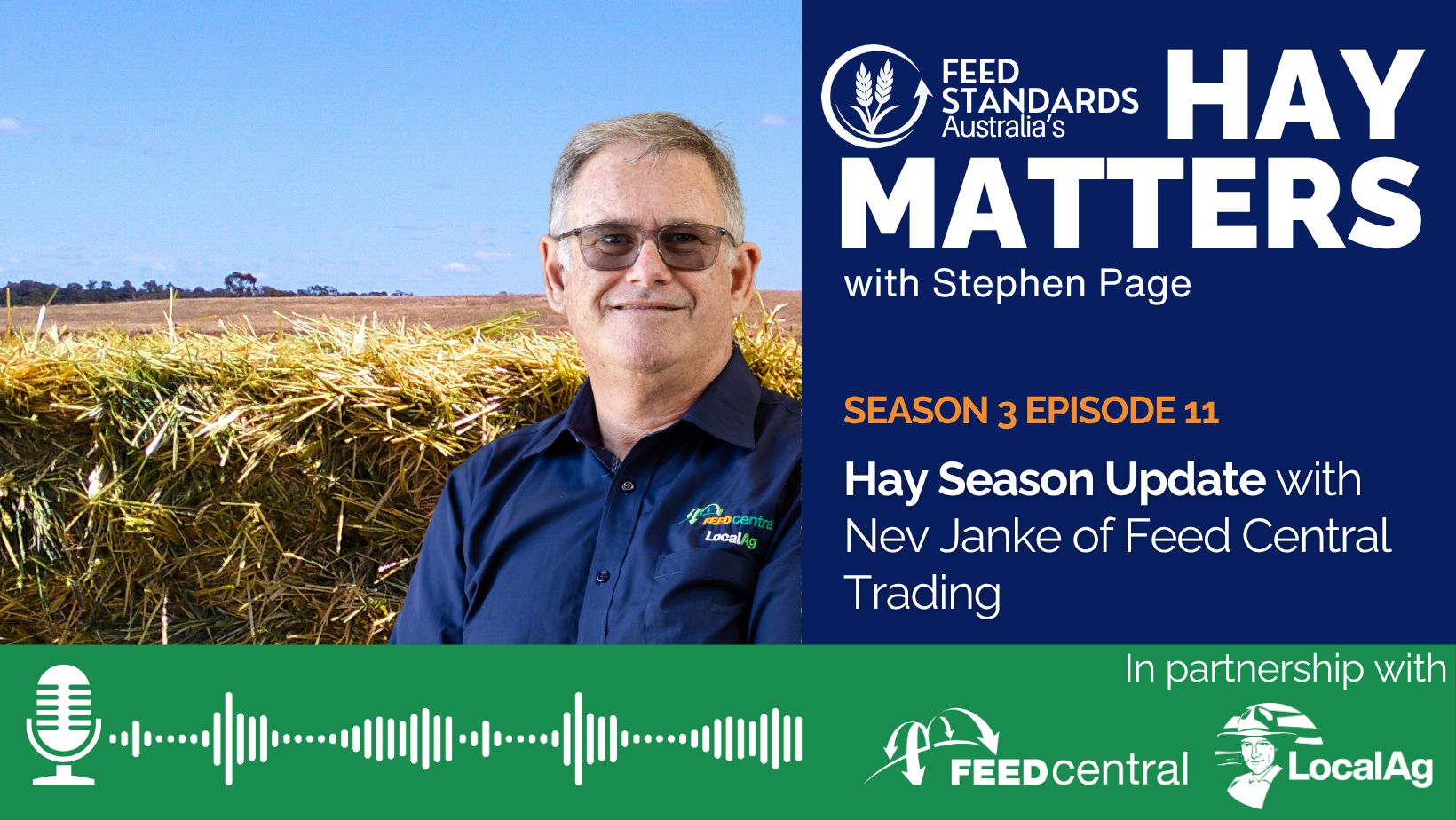
In this episode of Hay Matters, Feed Standards Australia Grower Services Manager Steve Page is joined by Nev Janke from Feed Central Trading for a look at seasonal conditions, hay production and the challenges that can affect quality.
Following his recent travels through New South Wales and Victoria, Steve shares what he saw in the paddock—from dry conditions and patchy crops in the north to strong yields and wet-weather delays further south.
Steve and Nev also discuss:
How delayed cutting can affect crop maturity and feed quality.
Why feed tests and quality certificates are valuable in a season with potentially large hay volumes.
Chemical records, withholding periods and the importance of accurate Commodity Vendor Declarations.
How the Seed to Feed program and Weed Safe can give buyers more information about qualifying hay lots.
Listing hay on Local Ag Marketplace before a quality certificate is completed.
Managing the risk of mice when grain is present in stored hay.
Hay Matters is brought to you by Feed Standards Australia, with partners Local Ag Marketplace and Feed Central Trading.
Read Transcript
00:00:06.000 –> 00:00:07.575
Tim Ford: Hello, I’m Tim Ford.
00:00:07.576 –> 00:00:17.890
Tim Ford: Welcome to Hay Matters, brought to you by Feed Standards Australia with our partners Local Ag Marketplace and Feed Central Trading.
00:00:17.891 –> 00:00:28.441
Tim Ford: Each episode, we share practical information, industry insights, and real experiences from across Australia’s hay and fodder industry.
00:00:28.442 –> 00:00:35.999
Tim Ford: Now let’s get into today’s episode with our podcast host and grower services manager Steve Page.
00:00:36.000 –> 00:00:40.534
Steve Page: Welcome to Hay Matters, the podcast from Feed Standards Australia.
00:00:40.535 –> 00:00:44.107
Steve Page: Today, Nev Janke from Feed Central Trading joins me.
00:00:44.108 –> 00:00:44.999
Steve Page: Welcome, Nev.
00:00:45.000 –> 00:00:46.026
Nev Janke: G’day, Steve.
00:00:46.027 –> 00:00:47.999
Nev Janke: It’s good to be with you.
00:00:48.000 –> 00:00:50.999
Steve Page: How things up in your area, Nev?
00:00:51.000 –> 00:00:54.907
Nev Janke: Oh, we’ve had some rain, Steve, and we’re pretty excited.
00:00:54.908 –> 00:01:07.999
Nev Janke: All Central Queensland’s had some spasmodic storms that have come through, and some some areas had up to 100 mil, so we we’re pretty excited through central parts of Queensland at the moment.
00:01:08.000 –> 00:01:10.481
Steve Page: How have they progressed through the winter, Nev?
00:01:10.482 –> 00:01:11.999
Steve Page: What’s their season been like?
00:01:12.000 –> 00:01:13.410
Nev Janke: Very dry, Steve.
00:01:13.411 –> 00:01:22.487
Nev Janke: It’s it is the the traditional dry time for all CQ and the northern part of the the southeast very dry.
00:01:22.488 –> 00:01:32.885
Nev Janke: They’ve got a good stand of dry feed, but then there’s the problem of getting enough dry feed lick out to the animals.
00:01:32.886 –> 00:01:51.038
Nev Janke: So they’ve been running a bit short of lick, but there’s good a good stand of of dry feed and that come off the back of a fairly good wet season that we had in the January, February rains that come through.
00:01:51.039 –> 00:01:57.999
Nev Janke: So that’s a little bit of an overview of what’s happened in Central Queensland.
00:01:58.000 –> 00:01:58.333
Steve Page: Right.
00:01:58.334 –> 00:01:58.611
Steve Page: Okay.
00:01:58.612 –> 00:01:58.889
Steve Page: Yeah.
00:01:58.890 –> 00:02:06.778
Steve Page: Well, as you know, around this southern Queensland and northern New South Wales, it’s been extremely dry, and we’ve had a pretty tough period.
00:02:06.779 –> 00:02:17.111
Steve Page: But over just the last couple of weeks, we’ve had well around Gundy (Goondiwindi) here a couple inches of rain, and there’s starting to be a bit of a green pick out there in the paddock.
00:02:17.112 –> 00:02:34.999
Steve Page: But anyway, we’ll get on with the podcast, and just wanting to discuss the beginning of the season and how it is shaping up, and the production and quality challenges ahead, along with the chemical residues and the importance of the commodity vendor declaration certificates that we’re going to talk about in this podcast.
00:02:35.000 –> 00:02:38.415
Nev Janke: Hey, that that’s some good topics there, Steve.
00:02:38.416 –> 00:02:40.812
Nev Janke: So as we start and run into that.
00:02:40.813 –> 00:02:51.999
Nev Janke: So, what have you seen over the last month or so that you’ve been on the road through the southeast part of Queensland, New South Wales, and Northern Vic?
00:02:52.000 –> 00:03:01.385
Steve Page: Yeah, so I had three weeks travelling down through New South Wales into Victoria and the south, and just as far south as Horsham.
00:03:01.386 –> 00:03:19.063
Steve Page: This mainly presenting the our award winners in that region, and just catching up, giving them their trophies, and also catching up with some our our participants with the seed to feed programme that we’re running, or we’ve expanded this year.
00:03:19.064 –> 00:03:27.721
Steve Page: So we’ve actually had quite a few new growers come into that, and that’s been quite an interesting project to be doing.
00:03:27.722 –> 00:03:46.999
Steve Page: And we’ve also included the Weed Safe attachment to that programme now too, so to help basically the sellers, you know, differentiate with their hay and show the actual buyers the extent that they are going to stop those weeds coming on to those buyers’ properties.
00:03:47.000 –> 00:03:49.708
Nev Janke: Hey, that’s exciting stuff, Steve.
00:03:49.709 –> 00:03:58.628
Nev Janke: I’m really looking forward to seeing how the Weed Safe side of it pans out, especially for us guys in the sales.
00:03:58.629 –> 00:04:02.531
Nev Janke: So, when you look at now the seasonal challenges.
00:04:02.532 –> 00:04:06.673
Nev Janke: What are you seeing as far as yields go and quality?
00:04:06.674 –> 00:04:13.999
Nev Janke: What do you expect in the feed tests and the results, and maybe even bale weights this year?
00:04:14.000 –> 00:04:26.236
Steve Page: Yeah, well, that’s as I say, Gundy’s very been very dry and southern southern Queensland, Northern New South Wales, down to about Coonamble has really had a difficult period.
00:04:26.237 –> 00:04:31.229
Steve Page: Also, don’t expect too much hay to be coming out of that region at all.
00:04:31.230 –> 00:04:34.394
Steve Page: West and heading south of Dubbo, it’s patchy.
00:04:34.395 –> 00:04:37.910
Steve Page: There’s been some variability in the actual crops.
00:04:37.911 –> 00:04:52.115
Steve Page: Some crops were planted early and got well established and up, where others, other areas, they held off due to lack of moisture and rain, and were planted quite late, really ended June into July period.
00:04:52.116 –> 00:05:00.061
Steve Page: So those those crops have really struggled with a fairly dry period to get established, but the early crops have.
00:05:00.062 –> 00:05:10.962
Steve Page: Have actually, you know, generally performed quite well with a tight finish, and should have good feed test results with high ME and crude protein results.
00:05:10.963 –> 00:05:17.642
Steve Page: And I would expect the relative feed values to be up around that 100 plus into the 100 and 20s.
00:05:17.643 –> 00:05:28.120
Steve Page: Majority of these, the early crops have been baled, and the late planting stuff is still waiting to get done, which will be quite late in the season.
00:05:28.121 –> 00:05:32.973
Steve Page: Further south, New South Wales, Victorian border, as you’d know, Nev.
00:05:32.974 –> 00:05:39.442
Steve Page: It’s they’ve had a fantastic year down there, very favourable with some fairly large yields.
00:05:39.443 –> 00:05:45.631
Steve Page: Some areas showing issues where the crops suffered from waterlogging and disease issues.
00:05:45.632 –> 00:05:48.655
Steve Page: Some of those paddocks are still quite wet.
00:05:48.656 –> 00:05:59.836
Steve Page: Growers with another rain event that’s come across recently are struggling to get machinery into paddocks to get it either cut or even get the balers in there.
00:05:59.837 –> 00:06:03.000
Steve Page: All the trucks to be loading those bales out.
00:06:03.001 –> 00:06:06.235
Steve Page: So there are some very wet regions down there.
00:06:06.236 –> 00:06:10.384
Steve Page: There’s been some in that New South Wales Vic border areas.
00:06:10.385 –> 00:06:17.487
Steve Page: Some of the vetch has been cut, and the early cereal crops in that region are now on the ground also.
00:06:17.488 –> 00:06:23.886
Steve Page: Since the trip in the last 10 days, some of these regions have had varying amounts of rain.
00:06:23.887 –> 00:06:27.684
Steve Page: I’ve been talking to one grower just north of Horsham.
00:06:27.685 –> 00:06:32.184
Steve Page: There, he’s at he’s had anywhere from 60 mil to 200 mil of rain.
00:06:32.185 –> 00:06:47.444
Steve Page: Yet just north of there, around that up round Swan Hill, up in that region, there’s been varying falls up in there of about 45 mil, but other, you know, sort of [place name unclear] areas only been about 10 to 15 mil.
00:06:47.445 –> 00:06:52.999
Steve Page: So there’s some variability in those falls that have been happening down there.
00:06:53.000 –> 00:07:10.882
Nev Janke: Hey, that’s a good news story that there is good rain in the south, and because good rain does grow good crops, so just expand a little bit, Steve, if you can, so we get to understand the the seed to feed programme and the weed safe programmes.
00:07:10.883 –> 00:07:16.818
Nev Janke: I understand that they’ll be all at the end or finished for this for this season.
00:07:16.819 –> 00:07:23.999
Nev Janke: So, how are they sort of rolling out, and and and what are we seeing going to transpire from that?
00:07:24.000 –> 00:07:30.489
Steve Page: So, Nev, the seed to feed programme then allows us to add a weed safe stamp to the lots that qualify.
00:07:30.490 –> 00:07:39.226
Steve Page: The weed safe gives buyers additional confidence by providing information about the crop’s history and the inspections it has undergone.
00:07:39.227 –> 00:07:46.999
Steve Page: It helps them to make a more informed decision about the risks of introducing unwanted weeds onto their onto their farms.
00:07:47.000 –> 00:07:48.886
Nev Janke: Hey, that’s exciting, Steve.
00:07:48.887 –> 00:07:53.264
Nev Janke: I really appreciate you sort of outlining that a little bit more.
00:07:53.265 –> 00:08:00.874
Nev Janke: Yes, to the sales team and to our clients, the Weed Safe programme will be very exciting when that rolls through.
00:08:00.875 –> 00:08:13.536
Nev Janke: Can you just give us a little bit, probably of the next little part that’s there when we have those commodity vendor decs, the CVDs, what chemicals are applied and the withholding periods.
00:08:13.537 –> 00:08:32.999
Nev Janke: Maybe you could give us a little bit of an outline because I hear that there’s some things about that VICTRATO and Lontrel and so for different chemicals and if you could just give us an update on some of those withholding periods and applications and so forth that’d be great thanks Steve
00:08:33.000 –> 00:08:46.148
Steve Page: Yeah so there are some challenges with that that’s for sure so you’ve got the seed dressings you’ve got the fungicides and then you’ve got the chemicals that we use to desiccate the crops.
00:08:46.149 –> 00:09:04.681
Steve Page: If if you do that process prior to cutting, and all those chemicals, you need to make sure that they are, you know, you’ve got a good record of those, and yeah, that it’s been considered before you even go in and cut those crops, the fungicides withholding periods.
00:09:04.682 –> 00:09:17.759
Steve Page: You might see that when you’re reading the labels, that there’s no withholding periods for grain harvest, but that doesn’t necessarily cover when you’re actually doing the hay production.
00:09:17.760 –> 00:09:38.600
Steve Page: Those requirements differ from grain to hay or straw production, so you just need to really have a close look at that before you make those decisions on either applying the chemical, or if you’re going in and doing grain, you’re cutting it and you’re going to think, okay, I’ll put this into straw.
00:09:38.601 –> 00:09:49.999
Steve Page: Well, that may there may be actual withholding period or an ESI on that product when you are selling it for how that buyer is going to be able to use that product.
00:09:50.000 –> 00:09:53.094
Nev Janke: Hey, that’s a good overview on that, Steve.
00:09:53.095 –> 00:10:00.576
Nev Janke: That’s great, and yes, it’s something that we always we check on as those commodity vendor declarations.
00:10:00.577 –> 00:10:11.223
Nev Janke: They must be filled out right because we got to make sure that the right products going into the right client for what their feeding operations are.
00:10:11.224 –> 00:10:19.999
Nev Janke: I believe now with all this new hay that’s that’s coming off and and being made and so forth, the inspectors will be busy.
00:10:20.000 –> 00:10:23.506
Steve Page: Yeah, now they will be, but we’ve got the opportunity.
00:10:23.507 –> 00:10:30.972
Steve Page: The way that we have changed now with local ag growers can actually have their hay up and advertised with Local Ag.
00:10:30.973 –> 00:10:44.282
Steve Page: They need to put in a put in a few photos, put in a bit of a description and a price, and it can be up and advertised and for sale out in the system, even before without getting a quality certificate done.
00:10:44.283 –> 00:10:54.476
Steve Page: So if they’re having to wait a couple weeks for an inspector to get there, it can still be up and advertised and being sold without that quality certificate.
00:10:54.477 –> 00:11:10.253
Steve Page: The big thing is this year is there are going to be some big crops, and some of the growers will be wanting to get their product advertised quickly, so that they’re going to have excess that may not fit in the sheds, and so that’s that’s good.
00:11:10.254 –> 00:11:17.784
Steve Page: But I do, yeah, it is important that we do still continue to get those quality certificates done and the feed tests.
00:11:17.785 –> 00:11:45.053
Steve Page: The year being such a big year with big production, like I’m hearing, you know, 10 tonne to the hectare sort of thing is is very realistic this year in some of those crops, and that those feed test results and that there’s you know that’s going to be a challenge to get them to a good standard where we have in previous you know last season we had some lovely hay being made, and that’s still in sheds in some locations.
00:11:45.054 –> 00:11:48.948
Steve Page: So it’s that’s going to be competing against each other too.
00:11:48.949 –> 00:11:51.999
Steve Page: So we have still got good quality hay in sheds.
00:11:52.000 –> 00:11:56.702
Nev Janke: Oh wow, Steve, that’s a that that’s a great way to wrap this up.
00:11:56.703 –> 00:12:06.767
Nev Janke: That the old season hay we could see as better quality and higher feed analysis there with MEs and proteins and and lower NDFs this year.
00:12:06.768 –> 00:12:24.988
Nev Janke: So so all in all, I guess for our clients that are looking to buy some quality hay to give us guys in the in the trading team and and a call and we can go through the different lots and and find what suits you and what suits the client at the time.
00:12:24.989 –> 00:12:26.971
Nev Janke: So no, that’s a great wrap.
00:12:26.972 –> 00:12:27.999
Nev Janke: Thanks, Steve.
00:12:28.000 –> 00:12:28.338
Steve Page: Yeah.
00:12:28.339 –> 00:12:29.015
Steve Page: Also, Nev.
00:12:29.016 –> 00:12:50.186
Steve Page: Just another point is with these weather events going through, some of those some of the growers have been putting off cutting, waiting for the weather to come through, and we have seen that some of the maturities in some of these standing crops before this weather event, they were starting to be at milky dough.
00:12:50.187 –> 00:12:59.927
Steve Page: So by by delaying the actual cutting, they could be into grain fill stage, and that again will give poorer results in the feed test results too.
00:12:59.928 –> 00:13:04.999
Steve Page: So that’s another thing that they’ve their consideration has to be made of.
00:13:05.000 –> 00:13:08.332
Nev Janke: Yeah, no, that’s a that’s a good point, Stephen.
00:13:08.333 –> 00:13:27.211
Nev Janke: I guess the other point that that that adds on to that is then if you do put hay into sheds that has got grain in the hay, you are then providing a mouse attractant to the shed perimeter, you really need a bunch of cats [unclear] in there just to keep the the rodents out.
00:13:27.212 –> 00:13:31.028
Nev Janke: So yeah, all in all, that’s that that’s a good wrap up.
00:13:31.029 –> 00:13:31.999
Nev Janke: Thanks, Steve.
00:13:32.000 –> 00:13:36.007
Steve Page: Yeah, Nev, that’s another point with the mice side of things too.
00:13:36.008 –> 00:13:46.610
Steve Page: There’s new regulations on what treatments they can be using around the sheds and that for mice control, so that’s another point that the growers have to be looking at too.
00:13:46.611 –> 00:13:52.836
Steve Page: If they have hay in sheds with some grain in them, what can they actually use and how do they use it?
00:13:52.837 –> 00:13:56.596
Steve Page: They’re going to have to be qualified to actually use it now.
00:13:56.597 –> 00:13:58.999
Steve Page: So those regulations have changed also.
00:13:59.000 –> 00:14:00.787
Nev Janke: No, well done, Steve.
00:14:00.788 –> 00:14:02.999
Nev Janke: Thanks for your [unclear].
00:14:03.000 –> 00:14:04.453
Steve Page: Righto, thank you, Nev.
00:14:04.454 –> 00:14:06.221
Steve Page: Thanks for joining us today.
00:14:06.222 –> 00:14:07.989
Steve Page: Lovely to talk to you again.
00:14:07.990 –> 00:14:10.958
Steve Page: And Nev, let’s hopefully we have a good season.
00:14:10.959 –> 00:14:14.999
Steve Page: And yeah, the growers can get good quality hay into their bales.
00:14:15.000 –> 00:14:15.999
Nev Janke: Bye for now.
00:14:16.000 –> 00:14:22.000
Steve Page: Thanks, Nev.
00:14:22.001 –> 00:14:23.999
Steve Page: Bye.
00:14:24.000 –> 00:14:30.881
Tim Ford: Tim Ford here again, and thanks to Steve for another great podcast.
00:14:30.882 –> 00:14:37.659
Tim Ford: Don’t forget to follow or subscribe in your favourite podcast app.
00:14:37.660 –> 00:14:44.541
Tim Ford: Leave us a rating and review, and share this podcast with a friend.
00:14:44.542 –> 00:14:58.919
Tim Ford: This podcast is hosted by Steve Page, presented by Feed Standards Australia, and sponsored by Local Ag Marketplace and Feed Central Trading.
00:14:58.920 –> 00:15:01.999
Tim Ford: And the music is by PianioYou.