A consistent national fuel-adjustment model for the Australian fodder industry.
The Feed Standards Australia (FSA) Fuel Levy model can work with all cargo; however, it has been built specifically for hay and straw freight.
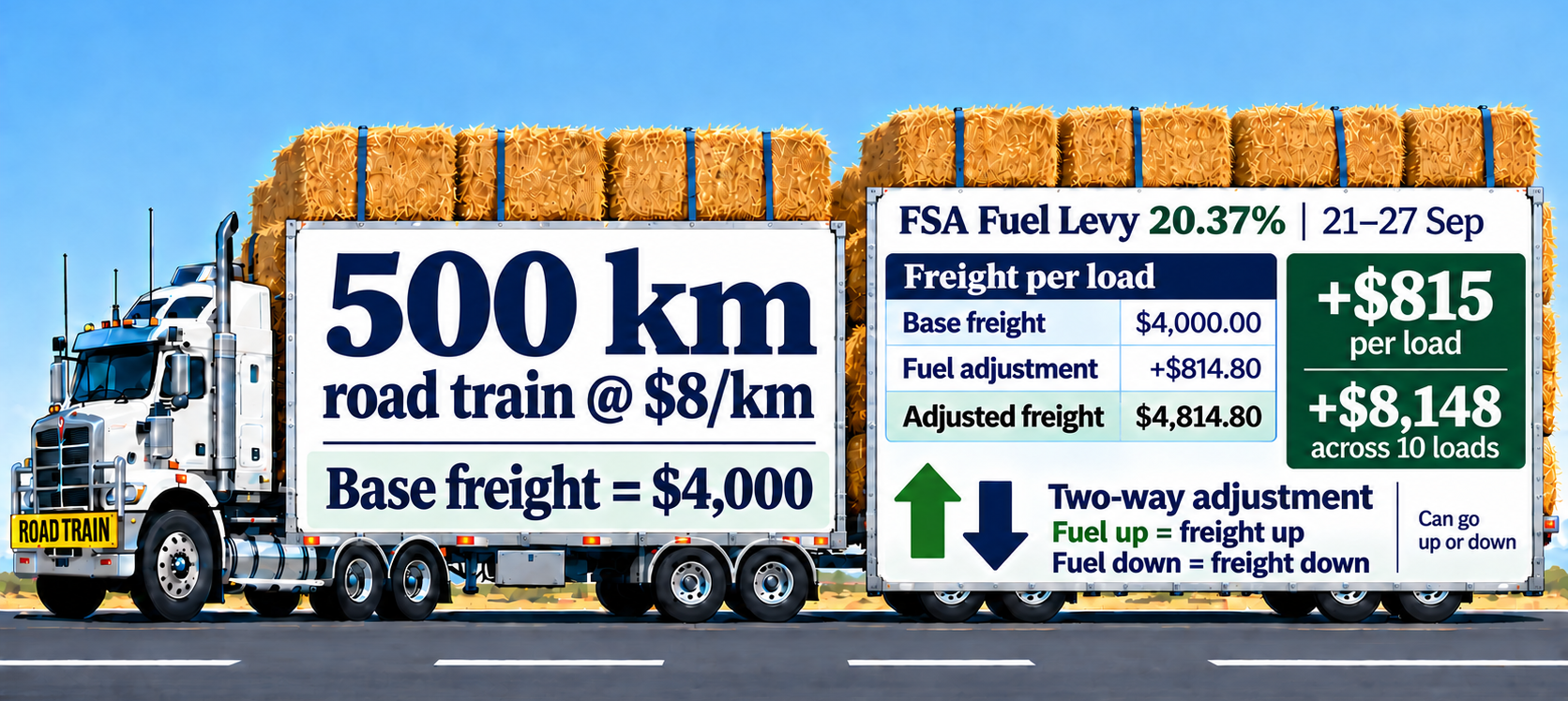
The Fuel Levy separates the agreed commercial price from future fuel-price movements. Buyers, sellers, carriers, traders and brokers can enter longer-term contracts without needing to predict where diesel prices will be in six, twelve or eighteen months.
| Two-way adjustment The adjustment rises when fuel rises and falls when fuel falls, including below the base fuel price. | One published reference A single weekly percentage based on the Sydney average diesel Terminal Gate Price (TGP). |
| Transparent contracting The underlying price is agreed separately from the variable fuel adjustment. | Ready for the contractual chain A documented rise-and-fall mechanism that supports consistent fuel-cost recovery. |
Access the Fuel Levy Calculator
The commercial problem
Why the fodder industry needs this model
Fuel is a significant component of road freight costs, but diesel prices can change substantially between the date a contract is agreed and the date the final load is delivered. This is particularly important in the fodder industry, where supply contracts may continue for more than twelve months.
Without an agreed adjustment mechanism, someone must carry the fuel-price risk. Sellers may build a contingency into delivered pricing. Carriers may quote conservatively or avoid longer-term work. Buyers may pay for a fuel increase that never occurs. Alternatively, the parties may be forced to renegotiate after the contract has commenced.
The purpose of the FSA Fuel Levy
Feed Standards Australia developed the model after considering fuel-adjustment approaches used in general, grain, livestock, machinery and other industries. Its purpose is to provide the fodder industry with one practical, transparent and two-way method of managing fuel-price movements.
Feed Standards Australia maintains the industry model and publishes the weekly fuel adjustment. It does not arrange the freight, invoice the adjustment or receive revenue from it. Participating businesses adopt the model within their own commercial contracts. Feed Central Trading will apply and administer it through its contracts and automated invoicing system.
Supporting long-term fodder contracts
The principal benefit is confidence. Parties do not need to agree today on what diesel will cost months into the future. The contract records the underlying price, and the published weekly fuel adjustment deals with future movement.
- Sellers can price fodder without carrying speculative fuel risk.
- Carriers can bid excluding the levy and compete on their underlying freight rate.
- Buyers receive reductions when fuel falls and pay only a proportionate fuel adjustment when it rises.
- Traders and brokers can administer contracts without repeated freight renegotiations.
Why the adjustment can go below zero
The levy is a true up-and-down adjustment against the base fuel price, rather than a surcharge that only ever adds cost. The carrier is compensated as fuel costs rise, and the buyer receives a corresponding reduction as fuel prices fall.
One model, shared confidence
Benefits across the supply chain
| Buyers Secure longer-term fodder supply with a verifiable adjustment. Receive reductions when fuel falls and pay only a proportionate fuel adjustment when it rises. | Sellers Agree the fodder price and base freight without forecasting diesel. Protect the sale from unexpected fuel movements and avoid repeated price negotiations. |
| Transport companies Bid for work excluding the fuel adjustment. Commit capacity to longer-term contracts without carrying the full risk of future fuel-price increases. | Traders and brokers Use one framework in quotations, contracts and invoices. Reduce disputes, compare freight offers consistently and maintain a clear calculation record. |
Access the Fuel Levy Calculator
Better freight bidding
Under the model, carriers bid their underlying freight rate excluding the FSA Fuel Levy. They do not need to guess the future diesel price or include a large fuel contingency. The same published adjustment can then be applied to competing bids.
This produces a more meaningful comparison of freight offers. It also means sellers do not need to charge today for a possible fuel increase that may never occur, while carriers are not asked to gamble on future diesel prices.
| Carrier bid | Without a common model | With the FSA model |
|---|---|---|
| Fuel assumption | Each carrier forecasts independently | Excluded from bid; one weekly fuel adjustment applies |
| What carriers compete on | Rate plus differing fuel contingencies | Efficiency, service, equipment, capacity and value |
Compliance
Supporting RTCCO compliance
The Road Transport Contractual Chain Order – Fuel Cost Recovery 2026 demonstrated that responsibility for fuel-cost recovery can extend beyond the transport company. A contractual chain may include buyers, sellers, traders, brokers, transport businesses, subcontractors and regulated owner-drivers.
The legal position depends on the actual contracts and arrangements in the chain, not simply the label used by a business.
What the 2026 Order required
While its fuel cost recovery obligations operated, affected primary and secondary parties were required to adjust rates regularly to compensate for increased fuel costs. Primary parties could also be required to take reasonable steps to ensure appropriate adjustments reached affected contractors and workers further down the chain.
The Fair Work Ombudsman states that existing rise-and-fall arrangements could satisfy the requirements where they adequately managed fuel-price changes.
How the FSA model helps
- Establishes an agreed fuel-price reference and base price.
- Provides one calculation method and a documented weekly adjustment.
- Creates a mechanism for fuel changes to pass through connected contracts.
- Produces records showing how the adjustment was calculated.
- Avoids having to negotiate a new mechanism after fuel has already increased.
Current status
The fuel cost recovery obligations under the 2026 RTCCO stopped applying from 7 June 2026, although the Order itself remains in effect. A standing contractual mechanism leaves the industry better prepared for future fuel movements and any applicable contractual-chain obligations.
General information only: RTCCO responsibilities depend on each party’s specific arrangements. Parties should obtain advice where needed.
Access the Fuel Levy Calculator
Practical guidance
Frequently asked questions
References
- Australian Institute of Petroleum – Terminal Gate Prices: aip.com.au/pricing/terminal-gate-prices
- Fair Work Ombudsman – Fuel cost recovery: Road transport order issued: fairwork.gov.au
- Freight Metrics – Fuel Levy Calculator and methodology: freightmetrics.com.au/fuel-levy-calculator