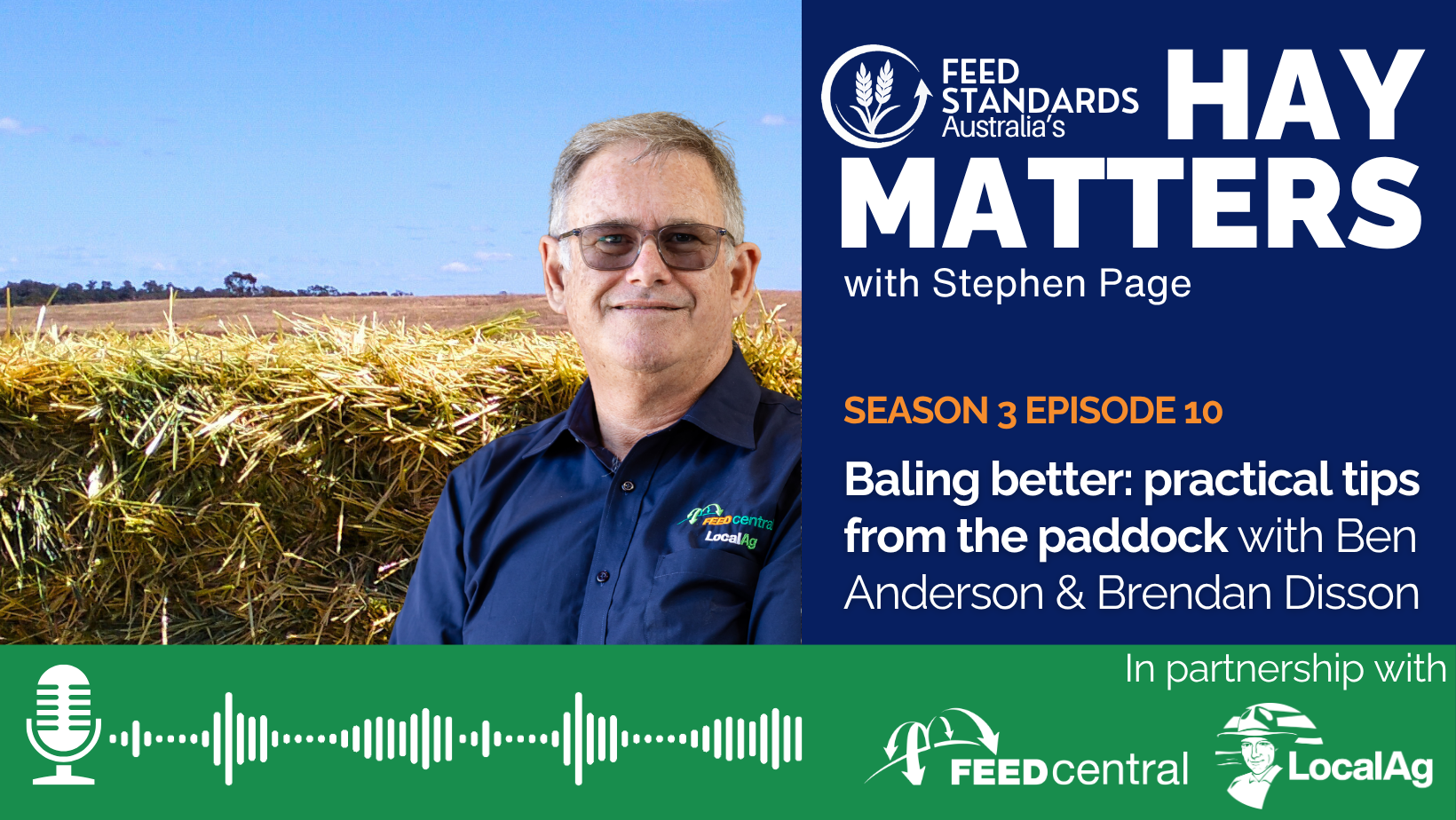
Join Steve Page in the paddock at Toowoomba Hay Farm for a practical look at round balers and the machinery decisions that influence hay quality and efficiency.
Steve is riding along with Ben Andrews from RDO and Brendan Disson from Kuhn, during a barley hay baling demonstration. Steve explores John Deere and Kuhn round balers, discussing automation, bale density, net-wrap access and choosing equipment to suit different operations.
The conversation also looks beyond the baler, covering mower-conditioner blade wear, roller maintenance and how windrow width affects crop flow and bale formation.
Whether you make your own hay or work with a contractor, this episode offers useful insights into getting more from your haymaking equipment.
In this episode:
- John Deere and Kuhn round balers in action.
- How automation can reduce operator workload.
- What mower blade wear can reveal about operating speed.
- Matching windrows to the baler for more consistent feeding.
- The importance of mower-conditioner setup and maintenance.
Thank you to Toowoomba Hay Farm for hosting and RDO Toowoomba for running the demonstration day.
Hosted by Steve Page and presented by Feed Standards Australia, with partners LocalAg Marketplace and Feed Central Trading.
Read Transcript
00:00:06.000 –> 00:00:34.000
Tim Ford: Hello, I’m Tim Ford. Welcome to Hay Matters, brought to you by Feed Standards Australia with our partners Local Ag Marketplace and Feed Central Trading. Each episode, we share practical information, industry insights, and real experiences from across Australia’s hay and fodder industry. Now let’s get into today’s episode with our podcast host and grower services manager Steve Page.
00:00:34.000 –> 00:01:28.000
Steve: Welcome to Hay Matters, season three and episode 10. In this episode, we’re at the Toowoomba Hay Farm. Thank you to Jared and the Toowoomba Hay Farm and the team from RDO Toowoomba for hosting this event and having us here. This episode, we’re reviewing the differences between the John Deere and Kuhn round balers as they set up and build some bales at the Toowoomba Hay Farm barley crop. I’m here today with Ben from RDO, and we’re on the Toowoomba Hay Farm, baling some round bales of hay. This has been cut about seven to eight days ago now, raked once, and we’re now baling it. Welcome, Ben. We’ve just pulled up to a load of bale. All’s going well. Can you give us a little bit of information on this baler and how it goes?
00:01:28.000 –> 00:01:47.000
Ben: Yeah. So today we’re baling with the the V452M John Deere round baler, the European spec round baler. It’s been going not too bad, so just certainly on our first bale now, and yeah, going good.
00:01:47.000 –> 00:01:57.000
Steve: And we’ve got two balers here today. We’ve got this one, the Kuhn. Can you give us a little bit of comparison between the two and how they fit into the market?
00:01:57.000 –> 00:02:22.000
Ben: Yeah, So, we actually offer three different round balers, mainly our European John Deere baler and the Kuhn. Two were very you know very well built, very strong balers, both targeted towards the larger owner operators and contractors. Both built with heavy chain bearings, auto greasers and the like. So yeah.
00:02:22.000 –> 00:02:31.000
Steve: And when you talk about the European side of things, can you explain that a bit more?
00:02:31.000 –> 00:02:54.000
Ben: Yeah. So our European baler out of France. Now would probably be our staple baler in our range, it’s yeah comes with a lot of features like automation. So, with a compatible tractor, we can have complete baler automation from stopping to opening and closing.
00:02:54.000 –> 00:03:15.000
Steve: So yeah, we get along at a reasonable speed. It’s a reasonably good crop. It’s for the season for around here. We had quite a dry season, but we’ve got reasonable amount of vegetable matter. Yeah. What sort of revs are you doing, and what sort of weights are you expecting to be able to get into these balers?
00:03:15.000 –> 00:03:24.000
Ben: Oh, I think today we’re aiming around that 250-300 kilos in bale weight.
00:03:24.000 –> 00:03:25.000
Steve: And they are 4×4’s?
00:03:25.000 –> 00:03:35.000
Ben: Yeah, we’re going reasonably steady here, and eight and a half km/hr.
00:03:35.000 –> 00:03:38.000
Steve: Yeah, Ben, what’s happening, mate? What are you doing?
00:03:38.000 –> 00:04:13.000
Ben: So, what happened is we left the net break on – being on a new roller is stuck to it, and then first bale of the day, it’s instead of letting go and rolling into the bale, it’s wrapped itself around that around this rubber roller. So that’s probably one of the biggest benefits of having a rear net on these bales. It’s being it’s an accessible fight to get to. We don’t have to worry climbing up or machine to get in there? And if you have, this type of thing, I mean, I probably should have put talcum powder on the at the start, which would have made it a lot better. But yep. Anyway, so the Kuhn actually have the netting in the front.
00:04:13.000 –> 00:04:18.000
Ben: Yeah.
Steve: Any other of the round barlers have the netting at the back or access to them?
00:04:18.000 –> 00:04:22.000
Ben: So both of our models, both the European and American ones have them at the back.
00:04:22.000 –> 00:04:24.000
Steve: Right.
Ben: Yeah.
00:04:24.000 –> 00:04:27.000
Steve: What else do you like to say about it?
00:04:27.000 –> 00:05:34.000
Ben: I think you know the technology available at the moment in both, or in all three of our balers, our baler range is pretty special. Like we don’t, I don’t think there’s many balers out there, or many guys really that are actually using, you know, bail automation or automation features to their potential, and yeah, they might be because the industry hasn’t yeah hasn’t got the tractors yet to hasn’t up their tractors capable enough of it. But I think in the future that these things will happen because they’re just so much easier for guys, especially like myself, that haven’t done a whole lot of baling, to come along and for it to do it for you. So, all you have to do is steer the tractor. And what is quite good is that in the future, you know, coming out of them that’s been released in the states is bale weaving automation. So it’ll weave for you to mow that perfect size baler, perfect even bale, as opposed to yeah me having to sit here now and weave to make sure the hay feeds are perfect. Yep.
00:05:34.000 –> 00:05:37.000
Steve: So this model here has only just come out in the last 12 months, eighteen months?
00:05:37.000 –> 00:06:18.000
Ben: Yeah. So this this baler was released, it would have been about this time last year, 2025. Its predecessor, the V451M, had about six years in the market, and it was a very good baler, good value for money for what it is in terms of build quality and how heavy it is. So you know we expect some good things out of this. You know we are a little bit further along too now with the automation side of it. So that’s going to be one thing moving forward as to how do this.
00:06:18.000 –> 00:06:20.000
Steve: That auto-steer will be good wont it?
00:06:20.000 –> 00:06:47.000
Ben: Yeah. Unfortunately, we see in a lot of industries is a lack of qualified labour involved in these things, and unfortunately, you got to put people that probably have never had a lot of experience into a tractor or baler and yeah, so helping totake some of that mode off the operator. It’s one benefit there. Yeah.
00:06:47.000 –> 00:07:30.000
Steve: Thank you, Ben, for showing us the workings of the Kuhn Baler. I’ll jump across to join Brendan now, who is operating the John Deere baler. So, I’m here with Brendan now. We’re who’s with Kuhn, and we’re out in the Toowoomba Hay Farms paddock, doing some round bales. What I’d like to start off with is the farm here has recently purchased a mower conditioner and just loved you to talk a little bit about that to us and about how that’s going. I love that comment you made on your knives and that, and what happens when you’re going too fast? Can we touch on that? You know, you said that that was a bit of a hot topic sometimes to some of your growers.
00:07:30.000 –> 00:08:44.000
Brendan: Yeah, no, but thanks, Steve. Yeah, no, definitely is a bit of a hot topic at times. You sort of point out to a few people that have been driving a bit quick and they won’t have it. But you sort of show them the telltale signs on their blades. So yeah, just to understand that what we’re talking about there. With your mower-conditioner, if you look at your blades, and then you’ve got a rounded edge on your blade – so your blade’s sort of wearing a bit uneven to a point. That there tells me straight away that you’re driving too fast in for the crops you’ve got. So technically your blade’s leaning back, sort of instead of being straight out. You’re angling back, so you’re cutting on the tip of your blade, not the whole part of your blade. So therefore, you’re prematurely wearing the blades there, and that one’s there. It also affects how the way your crop is cut too because you’re tearing the stems instead of cutting them clean.
00:08:44.000 –> 00:08:48.000
Steve: So tell us a bit more. What models of mower conditioner are there?
00:08:48.000 –> 00:09:48.000
Brendan: So the model we’ve got up there is a Kuhn S3561 TCS. So it’s a trailed centre tow steel roller machine. That one. So running 3.5 metre cut. Then we’ve also got the steel rollers. So as I was saying before, our steel rollerss have actually been designed for Australian conditions, and for most of the export hay market. So yeah, we’ve got a lot of guys, (Jason vows he’s been with the company over 25 years), and he’s done a lot of development with the factory on these mocos throughout the throughout the years, and yeah, so a lot of trial and testing. We designed the steel rollers, and yeah, we’ve got a very good product there at the end of the day. And another key feature with our mowers is the floatation system on them. They actually float fantastic across the ground got a lot of adjustment there in the tortion bar system. So yeah, we take pride in our hay equipment.
00:09:48.000 –> 00:09:56.000
Steve: So we’re kicking out quite a few bales here, and not a big distance. What sort of revs are we running at the moment? 1850 by the looks of it.
00:09:56.000 –> 00:10:50.000
Brendan: Yeah, so we’re running 1850, I believe. I think we’re doing about five. 510-530 PDA revs at the moment because we’ve got plenty of horsepower on this. We’ve got plenty of torque. We don’t need to run it flat out. We’re running. I believe this is a barley crop, so the row we are in right now is quite dense. I’ve been getting up to around that 10-15 km/hr, but because I’ve got to tweak it a little bit of an issue – probably a little bit narrow windrows. No hiccups, and we get great density. Even though we’re quite dry.
00:10:50.000 –> 00:10:55.000
Steve: So Toowoomba Hay Farm also purchased a Kuhn rake. Can you tell us a bit about that one?
00:10:55.000 –> 00:11:33.000
Brendan: Yes, they did. So they’ve got what they call it a GA6930. So, it’s a contractors machine, very well built. So that rake has got the features to do two individual rows. So max width that it does is 6.9 metres. So, with the two rows of the of the 3.5 mower-conditioners quite well, but also had advantage taking your wings off and then just turning your individual rows over at the same time. So it’s quite a versatile rake that one.
00:11:33.000 –> 00:11:37.000
Steve: So they used that rake this for today.
00:11:37.000 –> 00:12:16.000
Brendan: Yeah, they did. So you’ve actually got two into one with that rake. We probably could have even gone four to one on this crop. So that’s just horsepower on the front. We haven’t got any dirt. That’s the great design of the times of our our G8 model rake. So by the tine design you don’t actually have them anywhere near the ground, and they’ll still lift the product up off the ground or windrow.
00:12:16.000 –> 00:12:29.000
Steve: So just on this windrow here, setting a rake up, as you say, with this baler, it’s a bit narrower. How would you have changed that to make it better conditions for your baling?
00:12:29.000 –> 00:13:01.000
Brendan: So what we would have done, we would have spread the rake out a little bit wider. So everyone’s still learning to use the machinery at the moment. The wider the windrow, the better for the baler. So we run a 2.3 metre pickup on this. So, the wider the row, the less weave we have. As you probably noticed, we’re doing a lot of weaving, so all we do is put that windrow right off, throw it out a little bit wider.
00:13:01.000 –> 00:13:04.000
Steve: What width would you recommend with that? Two metres.
00:13:04.000 –> 00:13:25.000
Brendan: Yeah, two metres, two and a half. Two metres is a good size because they’ll fit under most tractors, so we’re not trying to run it over the crop too much. We’ll say two metre row and get a nice even bales throughout.
00:13:25.000 –> 00:13:32.000
Steve: So tell us a little bit more about this Kuhn baler, and where does that fit into the market? Is this the top of the line?
00:13:32.000 –> 00:15:12.000
Brendan: Steve? This is our 3260, so this is probably more so what we will call an entry level machine. So this 32 series. It’s a five foot, so bale size from three foot and five foot. So yeah, still running 50 and 60 beat chains, double race roller bearings throughout the whole machine, and you know, in good crop and good density, this system will probably, you know, get up to 3-400 kilos of dry hay in a bale with this baling. So yeah, these are a good sort of hay making every day baler for any contractor, any hay farmer as well. We also do a 71 series, which is above this. It’s an extraordinary machine, so we’re running those balers and four-foot balers with a minimum of 400 kilos in a four-foot baler, it is a cut above the rest when it comes to round balers and machines. So it’s all your heavy duty contractor, export hay market machine. So, for this entry sort of level one. If you’re a farmer buying it, what sort of number of bales would you be looking at to justify it? Well, these machines are pumping out about 300 to 500 bales a year to a couple of 1000 bales a year. If you’re doing excessive of 10,000 bales, you want to be looking at the 71 series, I’d say. But yeah, I’m more than comfortable running this thing at 10,000 bales a year.
00:15:12.000 –> 00:15:14.000
Steve: Anything else you’d like to chat on?
00:15:14.000 –> 00:15:48.000
Brendan: One thing we probably can always do is like a lot of people we go back to the mower conditioners and talk about their blades, and then there’s a lot of a maintenance on rollers that people sort of say don’t fully understand, and they should probably have been checked, every year, or a couple of times a season. So maintenance is a big thing through the hay gear, and so we’re always here to help with that as well.
00:15:48.000 –> 00:15:52.000
Steve: And where are you most?
00:15:52.000 –> 00:16:14.000
Brendan: So I’m over the Northern Rivers, New South Wales. So I’ve got a property between Casino and Kyogle. So yeah, as much as I’m working with machinery, we run a bit of hay at home and cattle. Which helps which helps in this particular role.
00:16:14.000 –> 00:16:17.000
Steve: So can I ask what baler do you have at home?
00:16:17.000 –> 00:16:44.000
Brendan: Well, unfortunately, I’m in a position where I can’t justify having my own baler, but I’ve got a couple of contractor mates that are up the road. Then my main contractor runs BB3165 Kuhn config balers. But yeah, but most of the time its done by a Kuhn baler. No, that’s one thing I can say.
00:16:44.000 –> 00:16:49.000
Steve: All right, thank you very much for your time. Lovely to be in front.
00:16:49.000 –> 00:16:51.000
Brendan: Thanks, man.
00:16:51.000 –> 00:17:10.000
Steve: That’s a wrap for this podcast. Thank you, Ben and Brendan, for the opportunity to ride along with you today and your expertise. Also, thank you to RDO for running the day and the Toowoomba Hay Farm for hosting the event.
00:17:10.000 –> 00:17:56.000
Speaker 1: Tim Ford here again, and thanks to Steve for another great podcast. Don’t forget to follow or subscribe in your favourite podcast app. Leave us a rating and review, and share this podcast with a friend. This podcast is hosted by Steve Page, presented by Feed Standards Australia, and sponsored by Local Aid Marketplace and Feed Central Trading. The producers are Cara Stewart and Denise Ellis. The audio editor is Ellen Ronalds Keene, and the music is by Piano Yu.