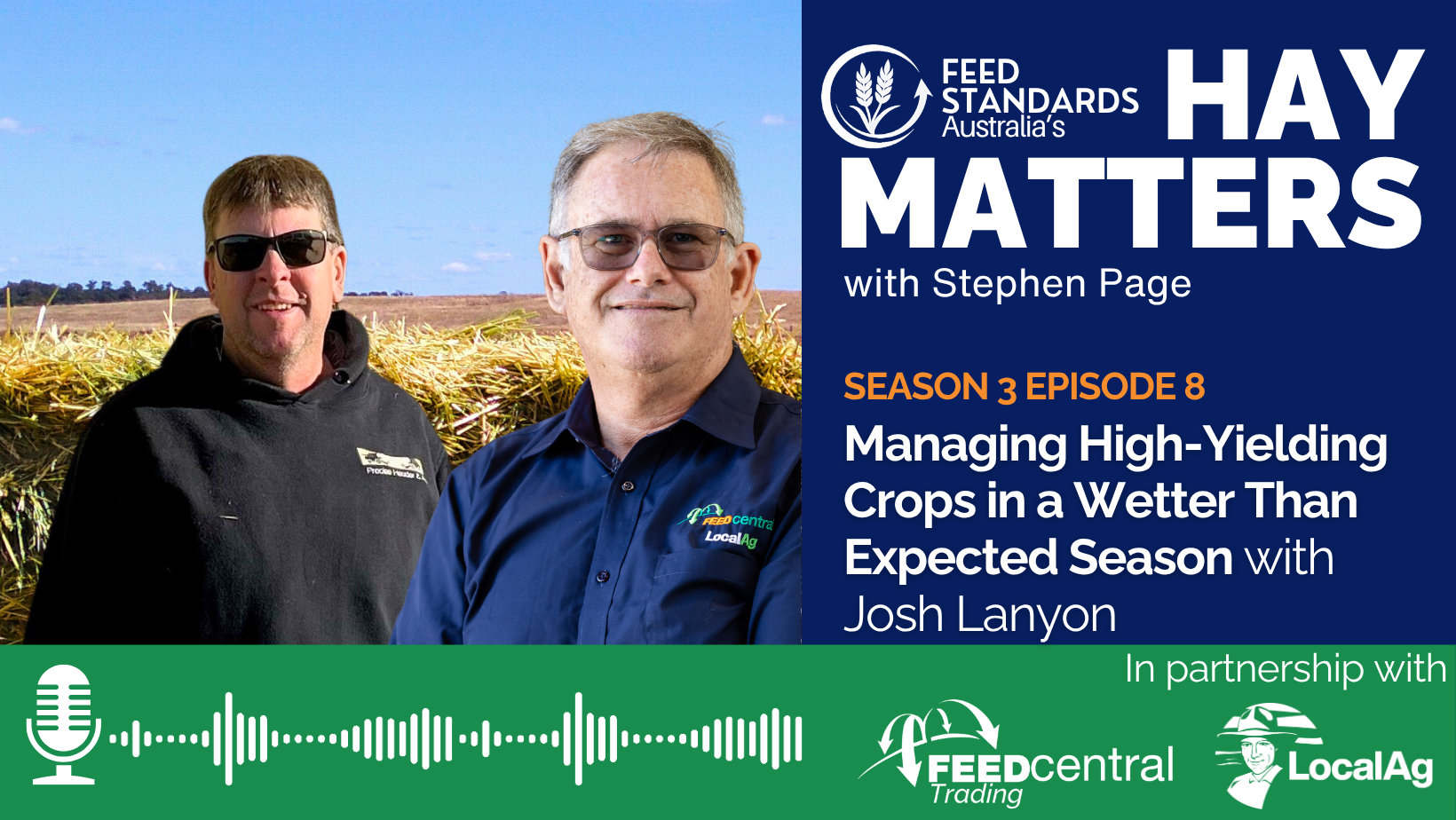
In this episode of the Feed Standards Australia podcast, Steve Page catches up with returning guest Josh Lanyon from Boort in the southern mallee region of Victoria, to discuss an unexpectedly wet growing season and the challenges of turning high-yielding crops into quality hay.
After beginning the year with drought conditions forecast, Josh’s district has experienced ongoing rain, saturated paddocks and waterlogged crops. He shares how the conditions have affected his vetch and oats, the yields he is anticipating and the difficult decisions that may need to be made when cutting begins.
Steve and Josh also discuss managing lodged crops, mower conditioning and raking strategies, along with the importance of cutting high-biomass crops at the right stage before feed quality begins to decline.
In this episode:
- The effect of waterlogging on vetch and oat crops
- Expected cutting times and potential hay yields
- Managing wet and inaccessible areas within paddocks
- Frost risk and decisions around hay versus grain
- Preparing machinery for tall, heavy or lodged crops
- Conditioning and raking strategies in wet conditions
- The challenge of curing vetch over saturated ground
- Protecting hay quality when weather windows are limited
- Storage, marketing and the outlook for the coming hay season
Josh’s key message is to cut on time and plan ahead. With large crops, delayed cutting can quickly reduce feed quality, while lodged crops and wet ground require careful thought about how mowing and raking equipment will be used.
Listen now for practical, paddock-level insights into managing a high-yielding hay season when much of the outcome remains in the hands of the weather.
Read Transcript
Tim Ford 00:06
Hello, I’m Tim Ford. Welcome to Hay Matters, brought to you by Feed Standards Australia with our partners Local Ag Marketplace and Feed Central Trading. Each episode, we share practical information, industry insights, and real experiences from across Australia’s hay and fodder industry. Now let’s get into today’s episode with our podcast host and grower services manager Steve Page.
Steve 00:34
Hello, and welcome to the Feed Standards Australian podcast. Today I’d like to welcome back Josh Lanyon from the Barraport region to discuss their season and the management of high-yielding crops. Hi, Josh.
Josh 00:34
Hey Steve.
Steve 00:36
Mate, can you just tell us how your season’s shaping up? What you’ve got in, and how it’s all going for you?
Josh 00:56
Yeah, it’s been a pretty interesting season so far. We started off with the forecast for the for the big drought year, and it hasn’t stopped raining since. So, we’ve got some pretty solid crops. We’ve got a lot of waterlogged crops. We’ve still got water running through the farm, which isn’t good, in the in the couple of weeks leading up to starting to cut hay. But I think on most of the higher ground, we should be pretty right if the if the weather starts to behave itself.
Steve 01:26
And so, what are you looking at through the paddocks at the moment? You said you’ve got water running through them. Are you looking at cutting those areas out differently, managing them differently, and just cutting the high ground, or what are your thoughts there?
Josh 01:39
A lot, a lot of vetch has died on the lower ground because it’s just been waterlogged for too long. The oats are handling it pretty well, but whether we’ll be able to get on them to cut them when they need cutting, we won’t know until the time comes. I’d assume we’ll have to leave out areas and harvest th just because it’ll be too wet to get the cutters on, but things can change pretty quick, so we can’t guess on that at the moment. And we’re sort of also just really hoping that that the tap does turn off, otherwise that might make things really hard. And we don’t want a giant stack of oat grain come January, so hopefully we can still get a lot cut.
Steve 02:28
Yeah, we’d love to see some of that rain you send up this way up into southern Queensland and northern New South Wales. We’re still quite dry up this way. But where’s your maturity and your crops at the moment? Where are you with the with your vetch and your oats?
Josh 02:28
The vetch has just got the odd flower starting to show, but not many. So I’d assume we’re about 14 days off cutting the vetch. The oats – there’s not a lot of not a lot of head emergence yet, but you can see it’s getting pretty close. So, we’ll assume we’re sort of three weeks of cutting oats. That would be the best guess.
Steve 03:07
And would that be a normal cutting period for you, or are you early or late?
Josh 03:14
That’d be pretty much on time. Often in these wetter sort of years, they’d be slower to mature, slower than you expect, so you might drag an extra week or so out of it.
Steve 03:27
And what sort of yields are you thinking you’re going to get? What percentage of your crop do you think you’ll not cut for hay now (that you had allocated to hay)? How much have you lost?
Josh 03:39
The vetch have probably lost 25 to 30% I guess. But the oats is a bit harder. The oats would be a much lower percentage at this stage. That could change pretty quick if we did get another solid rain.
Steve 03:55
Is that because it’s lodged, or is it just what what’s causing that loss in the oats?
Josh 04:00
Just the water logging, so we haven’t got a lot of lodging yet, but I’ll assume we will have a lot, and and that and that brings down yield a lot just because the mower just can’t pick it all up. So that at the moment we’d be sort of looking at six or seven tonne to the hectare crops, but that’s sort of anyone’s guess.
Steve 04:23
That’s in your oats, and that’s for hay?
Josh 04:24
yeah.
Steve 04:27
And so, when you walk in the paddock at the moment, what are your… you know you’ve had previous years’ experience and previous years in similar sort of seasons and conditions…What what would you be out there looking at now to start making these decisions, and are you looking at potential issues in some of your grain crops now, moving them to hay, or has that crossed your mind yet?
Josh 04:50
Well, try not to cut any other cereals for hay, just because there is so much moisture in the soil, and there are very, very big crops. Unless there’s frost and we have to cut them, we’ll definitely let them go through the green. Most decisions already made up. If we can get on the oats to cut them, that’ll be just business as usual, I guess. Yeah. And
Steve 05:19
And you’re still talking about potential frost risk, so you still got a frost risk down that way.
Josh 05:25
Yeah, that the barley hasn’t flowered yet. It might be starting to, but it’s pretty much out in here, so it it could be starting to flower a little bit. There was a little frost this morning.
Steve 05:39
Right. Okay. And when did that sort of cut-off date come for the frost? Do you think end of September?
Josh 05:47
Yeah, I think so. Yeah.
Steve 05:48
Yeah.
Josh 05:50
You could be a later one than that potentially. We generally haven’t had a lot of trouble with frost in the past, but the risks always there.
Steve 05:59
Yeah. So tell us going into these crops. So what is your management? Is there any change in your management from a normal season, and what would that be?
Josh 06:12
No, it’s hard to make any management changes at the moment because we can’t say we’re going to cut higher or anything like that, because if the crops lodged, well, we’ll just have to take it off at the ground anyway. So, there’s not a lot that’s out of our hands until the cutting starts. Really, the vetch we might have to rake a bit earlier than normal if it’s going in a really wet ground, but we’ll try and avoid that if we can. The cereals will just leave them alone. We might spray out more oats before we cut them, just to try have less regrowth once it’s dry. That’ll probably be fairly important. But sometimes in these sort of years, if we get a rain at the right or at the wrong time, it’s a bit hard to get that sprayer out onto the paddock three days earlier. So it will be a real touch and go sort of beginning to the cutting. I don’t think we’ll be working to as good a plan as what we normally do.
Steve 07:19
Yeah, and you’re talking about spraying out? What percentage would you normally do with that? And what do you use? And how many days in front of the actual cutting do you do that?
Josh 07:30
Most years we don’t spray any out in the cereals. Last year we did one paddock that was that had a lot of rye grass in it. But if we if we do it, it’ll probably be about three liters of Weedmaster, at 72 hours before we before we cut it, just because the crops are so tall, it does take a long time for that glyphosate to get through the crop.
Steve 08:00
And with your machinery side of things, what mower conditioner are you using, and how are you setting that? Would you set that up any differently for a bigger crop, a higher biomass?
Josh 08:12
We use self-propelled mowers with massy fronts on them that condition pretty well. That seems like higher risk when there’s if the weather is a bit unsettled, but we’ll probably just condition them as hard as we can anyway. That could lead to more weather damage, but it could get it off the paddock quicker too. So mowing will be pretty normal. I assume if the crops lodged, you’ll be able to cut it with a nice height going one way, then the other way. We’ll just have it on the ground to pick it up as best we can. So, there’ll be a lot of. We assume there’ll be a lot of stem length that isn’t cut, just laying flat. That does tend to want to stand up again once you cut it. That a fair sort of challenge with raking. We sometimes set up the V rake, so we just use one side at a time. So, we’re always raking in one direction across the paddock, and that picks up a lot less of that uncut stalk.
Steve 09:16
And the actual desiccation of that would also assist in that if it does get raked into the windrow or something would help with not causing as much issue?
Josh 09:26
Yeah, because especially if the crop doesn’t get baled for quite a little while, that uncut stem will possibly be totally dead. So even if the rate was to pick up a few stalks here and there, they’re probably okay in the bale.
Steve 09:41
Is that lodging mainly in the stem, that you think is going to happen, or is it going to be from the root base in the stems?
Josh 09:49
Yeah
Josh 09:49
And what we saw, if you get a good even rain, it all leans over one way nicely. But what I saw on the weekend, it just lent over at every direction. So that’s a lot harder to manage, but luckily that wasn’t over a very big area.
Steve 10:06
Right. And do you cut at an angle to your planting line, or do you still just go with the planting line on your tram lines?
Josh 10:15
Pretty much all our paddocks are west, so generally it leans to the east. We haven’t gained much in cutting on an angle in the past when it’s gone down. You think you’ll find a magic angle, but it doesn’t seem to be there.
Steve 10:31
And what is the weather forecast for you in the coming few weeks, if you believe any of it?
Josh 10:39
It sort of had to be dry, but that’s what they’ve said for the last six months. So, the 10-day outlook looks good, I think. Yeah, we’ll just we’ll just hope at this stage.
Steve 10:51
And so, looking at the long-term forecasts, they are predicting that we are going to go into a drier, hotter summer. What are your marketing plans for that hay? Get it in the shed and then then worry about it?
Josh 11:08
Yeah, that’s what we do every year. Just get it to the shed and worry about it later. We try not to sell too much out of the paddock just because it’s a big enough job just to get it baled and undercover. That’s the main priority, but depending on the demand this year, we can definitely make up the rules as we go, I guess.
Steve 11:30
And how are you sheds? Are they empty, or they still got some leftover product? There’s a bit of leftover product in Victoria at the moment.
Josh 11:37
Yeah, we’re pretty much empty. We’ve got a few tail ends, but pretty much empty. So that that’s looking good.
Steve 11:45
And where do you see the prices?
Josh 11:49
That’s a hard question, Steve. That’s very hard. It looks like there’s a lot of product around. It’ll depends on the quality, I think. If the quality, if a lot does get rained on, or cut too late, or whatever the problem being to bring the quality down – that generally brings the whole market down.
Steve 12:09
Yeah, there’s still some good quality product down in the sheds in Victoria from last season. There’s not much market out there for it at the moment.
Josh 12:19
I assume it’ll be pretty quiet during harvest.
Steve 12:26
Yeah. So, Josh, just summing up, if people are listening to this and wondering, what they’re going to do and they’re going to make hay, what are your main recommendations about getting quality hay into the bales?
Josh 12:38
I think having it on time will be really important because the crops are big. If you’re late cutting them, it really is going to end up being straw pretty quick. So hopefully the weather’s behaving itself when we need to cut it and then think about raking, that’s going to be hard if the crops are lodged a bit. Just doing that as best you can and plan ahead with the right gear and how you attack it, and really most of the rest of it’s in the hands of the weather Gods. It’ll be hard to evenly cut higher to keep it off the ground at this stage, I think. Assuming that, a lot will end up lodged, but hopefully that doesn’t happen, and the vetch – well, that going to be even harder because if we were cut earlier, and we’re getting little fogs a lot of mornings, and the ground’s still saturated. So, keeping quality in vetches is going to be hard work. We’re going to need a few warm, windy days pretty quickly after we cut it.
Steve 13:42
So cutting your vetch, how often would you? How how quickly would you rake it? And how often are you looking at?
Josh 13:48
We used to rake it just once in front of the baler, but really that was more suited for years that were a bit drier. So, I knew this year the plan will be to make the windrows quite wide behind the mower, maybe two or three or four days (once it once it just wilts a little bit, but before it bleaches) maybe pull it together with a rotary rake onto a bit of dry ground in the middle. If the seven-day forecast is still good, but I don’t think we’ll just leave it sitting behind the mower, I think it’ll just start to go mouldy and take forever, but the weather can change pretty quick in Spring and that might help us change our mind too.
Steve 14:35
All right. Thanks, Josh. Great to catch up with you again, and I’ll see you later on the season. Thank you very much.
Josh 14:41
Thanks, Steve.
Tim 14:46
Tim Ford here again, and thanks to Steve for another great podcast. Don’t forget to follow or subscribe in your favorite podcast App. Leave us a rating and review, and share this podcast with a friend. This podcast is hosted by Steve Page, presented by Feed Standards Australia, and sponsored by Local Ag Marketplace and Feed Central Trading. The producers are Cara Stewart and Denise Ellis. The audio editor is Ellen Rolls Keane, and the music is by Piano Yo.