ME is the number that ultimately determines whether your animals will maintain condition, gain weight, or produce milk.
Protein builds the engine — but energy fuels it.
If ME is wrong, production suffers. It’s that simple.
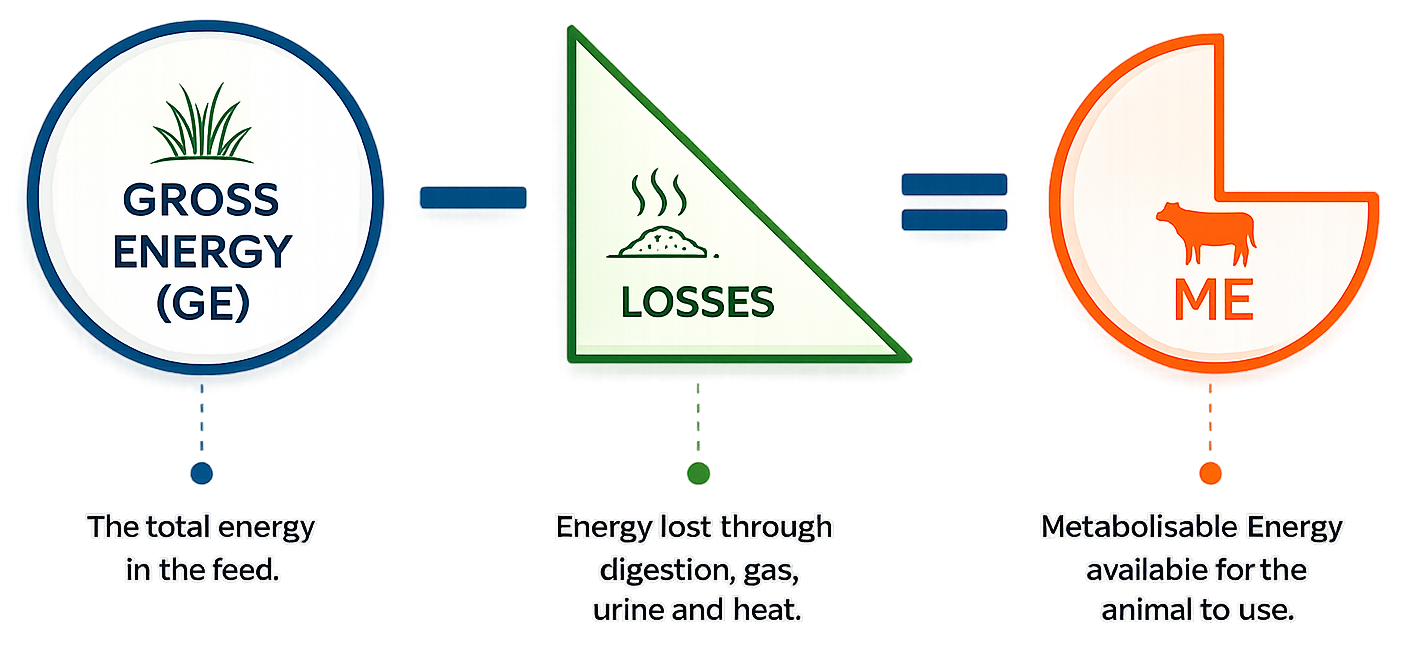
So, what is Metabolisable Energy?
Metabolisable Energy represents the energy available for the animal to use after accounting for losses in:
- Faeces
- Urine
- Gas production (particularly methane in ruminants)
ME is therefore a far more accurate measure of usable energy than Gross Energy.
ME is usually expressed as: MJ/kg of Dry Matter (MJ/kg DM)
Why ME Matters
Energy drives: | Inadequate ME |
|
|
|
|
|
|
|
|
|
|
Unlike protein deficiencies, energy shortages often show up fast and visibly.
Typical ME Levels in Common Feeds
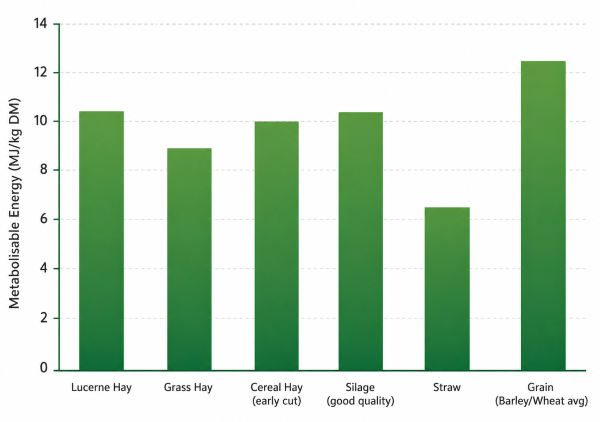
As shown in the graphic below, ME varies significantly across feed types.
Cutting time, maturity stage, and seasonal conditions significantly influence ME — which is why we recommend a Feed Test with your Visual Assessment.
Approximate values (MJ/kg DM):
- Lucerne hay: 9.5 –11
- Grass hay: 8 –10
- Early-cut cereal hay: 9 –11
- Good quality silage: 10 –11
- Straw: <7 Straw is fibre-heavy but low in usable energy.
- Grain (barley/wheat): 12 –14 Grain is energy-dense.
Typical Metabolisable Energy Levels in Common Feeds
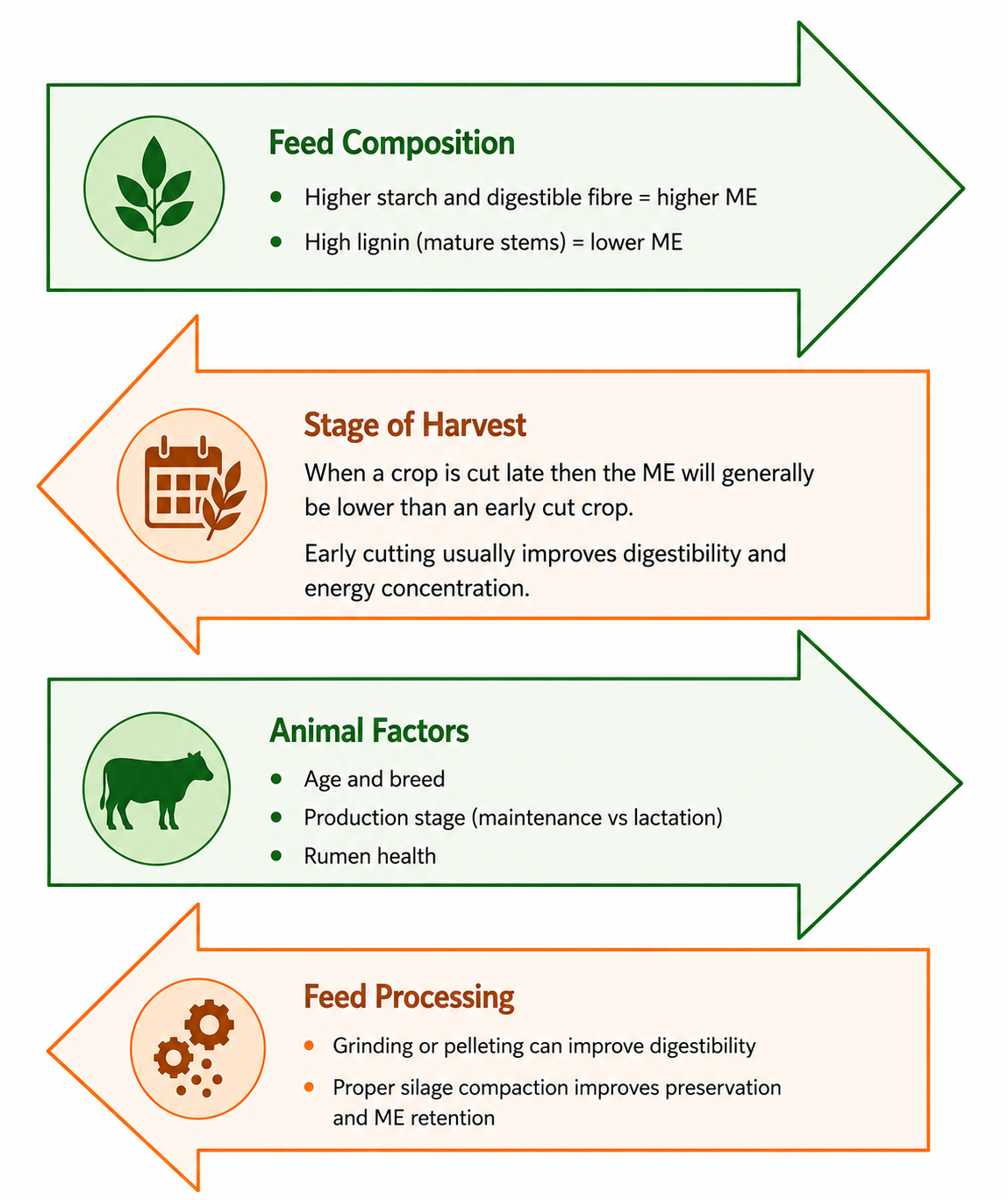
What Influences ME & ME utilisation of Feed?
Several factors determine how much energy animals can use:
ME vs Other Energy Systems
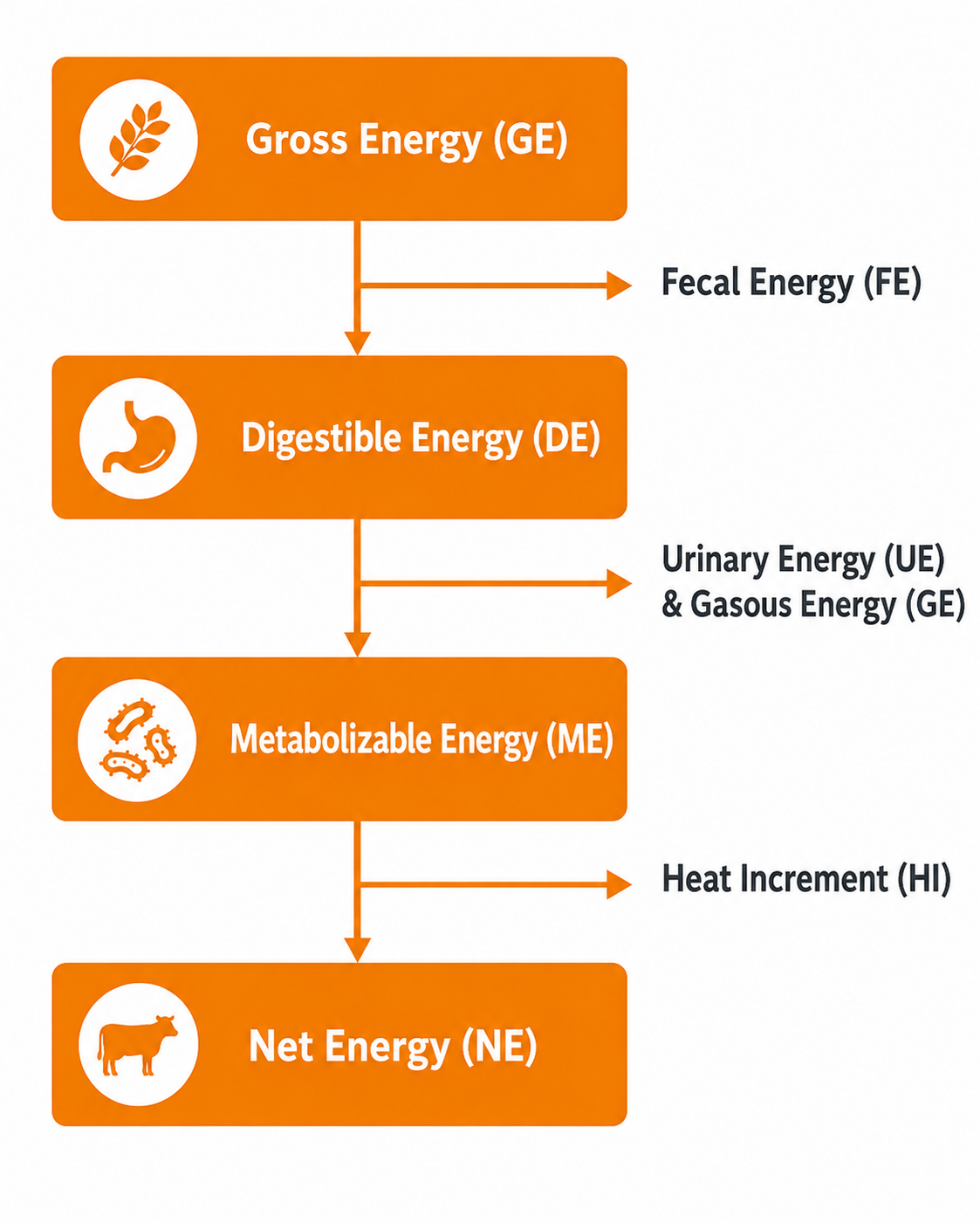
You may also see:
- Gross Energy (GE) – total energy, not accounting for losses
- Digestible Energy (DE) – energy available after digestion (GE minus faecal energy loss)
- Net Energy (NE) – energy available after heat losses (GE minus faecal, urinary, gaseous and heat energy loss)
In Australian ruminant systems, ME remains the most practical and widely used energy system for diet formulation.
The Relationship Between ME and Protein
It is essential, when formulating a ration, that both Crude Protein and Metabolisable Energy are considered.
High CP with low ME = wasted nitrogen.
Low CP with adequate ME = limited microbial growth.
The rumen requires both nitrogen (from CP) and fermentable energy (from ME) to function efficiently.
Balance drives performance.
How NIR Testing Improves ME Accuracy
Modern NIR testing provides rapid, accurate ME estimation across multiple feed types including hay and silage.
Compared to book values, NIR results:
- Reflect seasonal variation
- Capture maturity differences
- Account for real-world paddock variation
- Allow more precise supplementation decisions
Given how much ME influences production, testing every lot before feed-out is simply good management.
Practical Takeaways for Producers
Before feeding out a new lot of hay or silage:
- Test for ME — don’t rely on visual quality.
- Check Dry Matter (DM) to ensure intake calculations are accurate.
- Balance ME with CP and NDF.
- Adjust grain inclusion based on actual energy supplied.
- Monitor body condition and milk performance closely when changing feeds.
Energy drives production, and production drives profitability.
Final Word
Metabolisable Energy is not just another number on a feed test.
It is the foundation of:
- Milk in the vat
- Weight gain in the paddock
- Fertility in the herd
- Feed efficiency across the business
If you want consistent performance, start with accurate ME testing.
Talk to your local rural store about Feed Central testing satchels — or get in touch to interpret your latest results.