Why Test Hay and Silage for Selenium?
Testing becomes particularly valuable when:
- hay or silage has been purchased from an unfamiliar district;
- fodder is being transported between regions;
- the farm is in a known low-selenium district;
- livestock are relying heavily on conserved forage rather than pasture;
- young or rapidly growing livestock are being fed;
- pregnant or lactating animals are being fed;
- unexplained ill-thrift, poor growth or reproductive performance is occurring;
- there is a history of white muscle disease;
- animals are already receiving selenium through drenches, vaccines, pellets or mineral supplements and the producer wants to assess the total selenium supply.
Feed Standards Australia can arrange selenium (Se) testing for an additional fee upon request with any feed test submitted.
Where Is Selenium Deficiency Most Likely?
Selenium deficiency is strongly associated with particular soil, rainfall and pasture conditions. While a state such as WA may have soil conditions that suggest deficiency, it is important to confirm by testing, as not all areas have the same soil conditions.
Australian risk factors include:
- sandy soils;
- granite-derived soils;
- acidic soils;
- some sedimentary soils;
- higher-rainfall areas;
- clover-dominant pastures;
- lush, rapidly growing spring pasture; and
- long-term or heavy use of sulphur-containing fertilisers such as superphosphate and gypsum.
MLA identifies selenium deficiency particularly with coastal sandy, acidic, sedimentary and granite soils, commonly in higher-rainfall regions.
Australian areas worth highlighting
Victoria
- Gippsland, including documented selenium deficiency on sandy soils in East Gippsland.
- Other marginal selenium districts occur throughout Victoria, particularly where susceptible soil types and higher rainfall coincide.
New South Wales
- Tablelands are an important risk area.
- NSW DPI identifies annual rainfall above approximately 450 mm, acidic basalt/granite or sandy soils, clover dominance and particular fertiliser histories as major risk factors.
Western Australia
- Selenium deficiency and white muscle disease have also been documented in Western Australian sheep-producing regions.
Region is a risk indicator, not a diagnosis. Selenium can vary between adjoining properties and even between paddocks.
When During the Year Is Risk Greatest?
Agriculture Victoria reports that selenium concentrations in pasture can be lowest during spring and summer, while clinical problems can become particularly apparent in good seasons with abundant spring pasture growth.
This can seem counterintuitive: excellent pasture growth does not necessarily mean excellent trace-mineral nutrition.
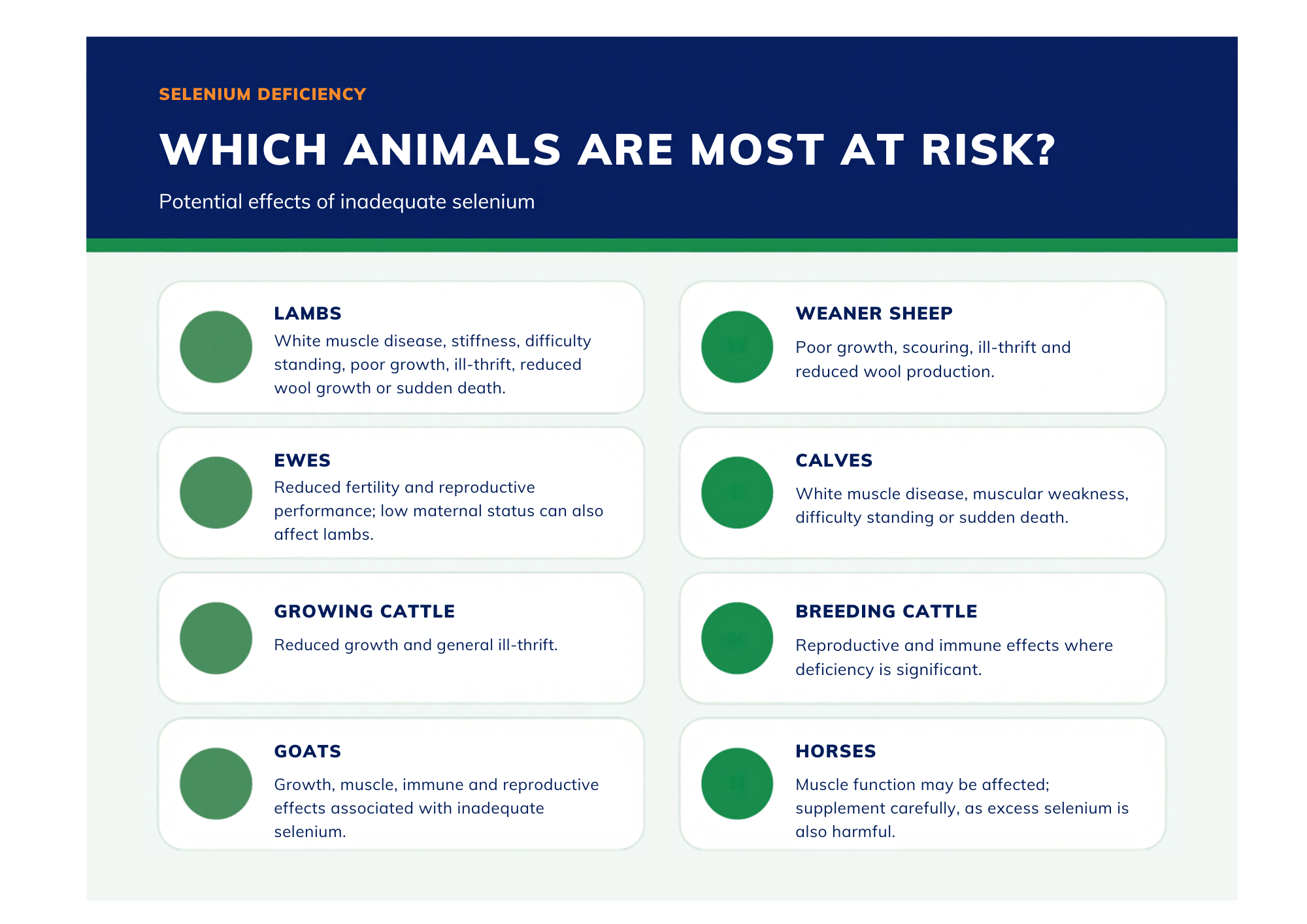
Young, rapidly growing animals have particularly high requirements. Agriculture Victoria notes that growing lambs require around twice as much selenium in their diet as adult sheep.
What Selenium Level Should We Look for in Hay or Silage?
Be aware that there isn’t one universal “ideal selenium level” for every bale of hay or silage. Consult with your nutritionist before you choose a plan of action.
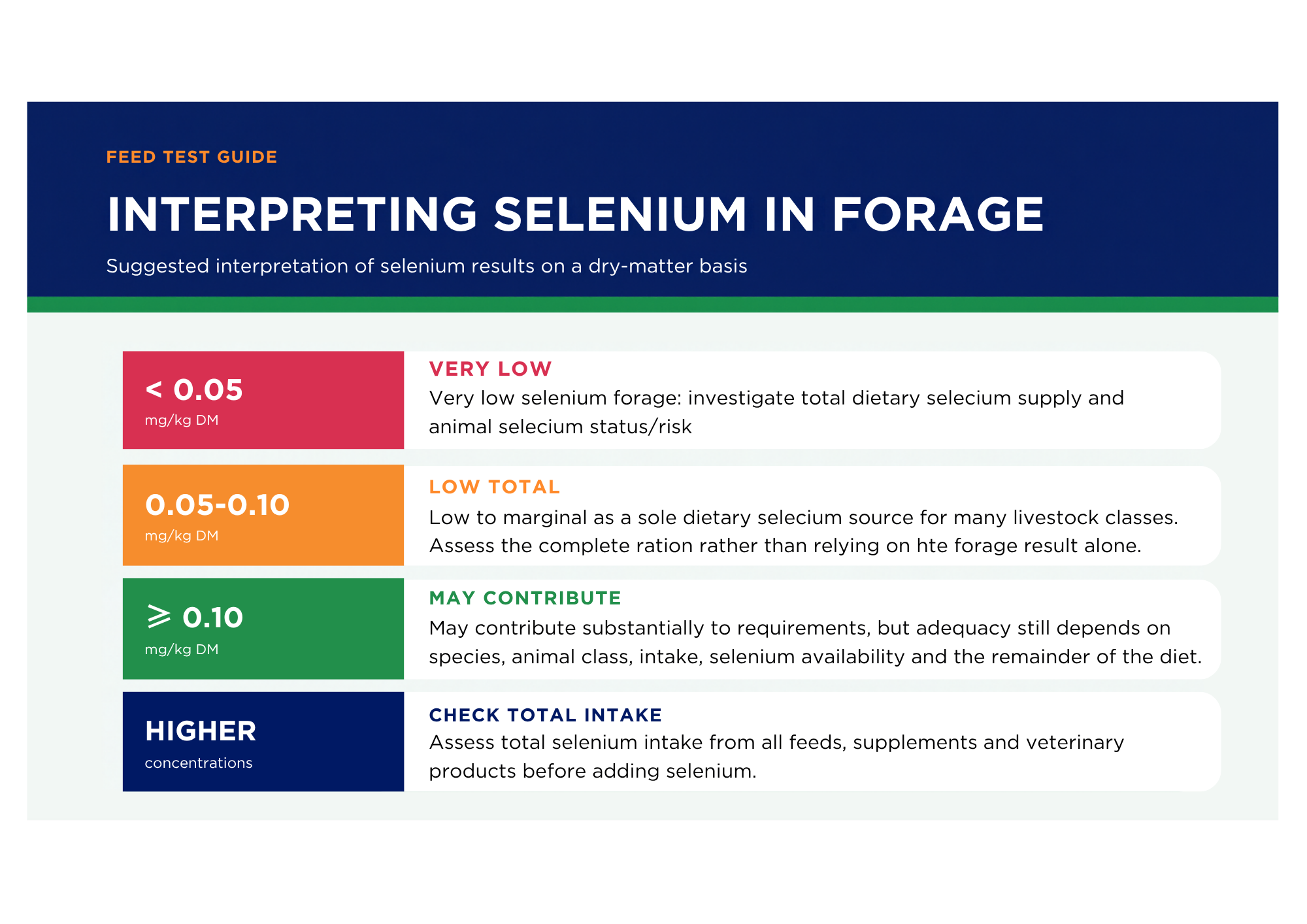
We don’t promote a universal “ideal” concentration. Hay or silage is only one component of the diet. Requirements vary according to species, age, growth rate, pregnancy, lactation and total feed intake.
The better question is:
How much selenium is the animal receiving from the whole diet?
That includes pasture + hay/silage + grain + mineral supplements + selenium-containing veterinary products.
Don’t Forget Selenium Toxicity
This is an important counterpoint to deficiency.
NEVER use “just in case” supplementation when considering Selenium.
Excessive selenium can cause toxicity, and risk increases when producers unknowingly combine several selenium sources—for example:
selenium-containing forage + mineral lick + selenium drench + selenium-containing vaccine.
APVMA specifically warns about concurrent selenium sources, including pasture treatment, pellets, drenches and vaccines.
What Selenium Supplements Are Available in Australia?
Animal supplementation
Australian producers may encounter selenium through:
- selenium-containing vaccines;
- oral drenches containing selenium;
- selenium/vitamin E injectable products;
- slow-release selenium pellets or boluses;
- mineral lick blocks;
- loose mineral supplements;
- compounded feed supplements and premixes; and
- supplements containing selenium alongside other trace minerals.
Pasture supplementation
Selenium can also be incorporated into appropriately registered fertiliser programs in selenium-deficient areas.
However, Agriculture Victoria specifically cautions that excessive selenium application to pasture can induce toxicity.
Recommended advice: supplement only after establishing that additional selenium is required and involve a veterinarian or livestock nutrition adviser where animal deficiency is suspected.
Are There Meat Withholding Periods?
The APVMA Veterinary Labelling Code states that there is generally a 0-day withholding period (WP) or export slaughter interval (ESI) for products containing minerals, including selenium. However, always follow the withholding period and Export Slaughter Interval printed on the label of the actual product being used.
Feed Testing vs Animal Testing
An important technical distinction to consider.
Feed testing answers:
“How much selenium is being supplied by this hay or silage?”
Animal testing answers:
“What is the animal’s selenium status?”
Where clinical deficiency is suspected, veterinary investigation may include blood testing or post-mortem liver testing. Agriculture Victoria specifically notes that animal selenium status should not be diagnosed from pasture or soil testing alone.
The two approaches therefore complement rather than replace one another.
Test Before You Supplement
Selenium is essential, but more is not necessarily better.
Where hay or silage represents an important part of the ration—particularly for young, growing, pregnant or lactating stock, or where fodder originates from a selenium-deficient district—knowing its selenium concentration provides valuable information before deciding whether supplementation is required.
Know what your forage is supplying. Feed Standards Australia offers Selenium (Se) testing for an additional fee upon request with any feed test submitted. Ask for selenium testing when submitting your hay or silage sample, particularly when feeding susceptible livestock or sourcing fodder from an unfamiliar region.