When reviewing any feed test — whether it’s lucerne hay in northern Victoria, cereal silage in Gippsland, or pasture hay in Tasmania — Crude Protein (CP) is one of the first numbers we look at. But CP is more than just a percentage on a lab report. It tells a story about nitrogen supply, rumen function, animal performance, and ultimately profitability.
What exactly is Crude Protein?
Crude Protein represents the total nitrogen content within a feed sample, converted into an estimated protein value. The term “crude” refers to the testing method — not the quality of the feed.
Traditionally, protein has been measured using the Kjeldahl method, developed in 1883. This process measures total nitrogen in a sample, then multiplies it by a factor (usually 6.25) based on the assumption that protein contains 16% nitrogen.
However, not all nitrogen comes from true protein.
Some items that also contain Non-Protein Nitrogen (NPN), are:
- Urea
- Ammonia
- Uric acid
- Free amino acids
- Amine compounds
In ruminants, NPN can still be valuable because rumen microbes convert nitrogen into microbial protein — provided there is adequate energy available.
Key point: CP is a reliable indicator of overall nitrogen supply, but it can include nitrogen that isn’t true protein. This is why CP is a powerful, but not perfect, measure.
Let’s consider why Crude Protein is Critical in Ruminant Diets?
Protein drives:
- Growth in young stock
- Milk production in dairy cows
- Reproductive performance
- Muscle development and weight gain
- Microbial protein synthesis in the rumen
In dairy systems particularly, insufficient CP can quickly reduce milk yield and milk protein percentage. Conversely, excessive CP without adequate energy can lead to nitrogen wastage and elevated milk urea nitrogen (MUN) levels.
Balance is everything.
Higher CP does not automatically mean better performance — energy and fibre must align. Rumen microbes can use NPN — but only when there’s enough fermentable energy available. That’s why CP must be interpreted alongside energy (ME) and fibre (NDF/ADF).
Note: Grain can lift CP significantly, so any hay with grain present should be assessed carefully when ration balancing.
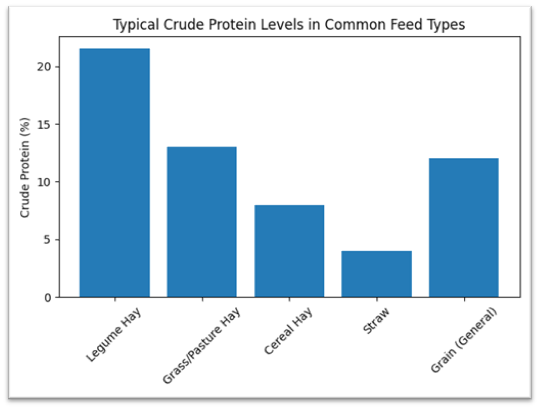
Typical Crude Protein Levels in Common Feeds
As shown in the graphic above, CP varies significantly across feed types:
- Legume Hay: 18–25%
- Grass / Pasture Hay: 10–16%
- Cereal Hay (cut early): 6–10%
- Straw: <5%
- Grain (varies by type): commonly 9–14%
Legumes such as lucerne and vetch typically test highest. Cereal hays generally test lower in protein but often carry higher Metabolisable energy if cut at the right stage.
Straw provides fibre but minimal protein and must be balanced accordingly.
Importantly, grain presence in hay can significantly influence CP levels — which is why we recommend a visual inspection to accompany a Feed Test where-ever possible.
How CP helps you choose the right hay or silage
When deciding what to purchase, CP often determines whether the feed suits your livestock class:
- High CP feeds (e.g. legumes) suit lactating cows, young stock, or high growth targets.
- Lower CP feeds (e.g. cereal hay) can suit mature stock needing maintenance or weight gain — when energy is adequate.
- Very low CP feeds (e.g. straw) should be considered fibre sources and usually require protein supplementation.
What Makes NIR Testing So Valuable?
With modern NIR (Near Infrared Reflectance) testing, as used in Feed Central analysis, CP is broken down further into:
- Available Protein
- Soluble Protein
- Degradable Protein
This gives a much clearer understanding of how much protein is usable by the animal — not just the total nitrogen present.
For ruminants, understanding degradability is critical for matching rumen energy supply and optimising microbial efficiency.
Practical Takeaway for Producers
When purchasing hay or silage, CP often guides the buying decision. But the smartest approach is:
- Test every lot (hay and silage vary more than most people expect).
- Use CP as a starting point — then check ME and NDF/ADF for balance.
- Don’t assume “higher CP = better”. Excess protein without energy can be wasted.
- If CP is low, plan supplements early (protein meals, urea strategies, higher-protein forages).
- If CP is high, confirm you have the energy to utilise it efficiently.
A feed test isn’t just a number — it’s a management tool.
Understanding Crude Protein properly allows you to:
- Avoid underfeeding or overfeeding protein
- Improve milk yield consistency
- Optimise weight gain
- Reduce nitrogen wastage
- Protect profit margins
In short — CP matters in every feed test because nitrogen drives production.
And production drives profitability.
Want help interpreting your results?
A feed test is only valuable if you use it to make decisions. If you’re unsure what your CP result means for your herd or ration, we can help.
Call Feed Central or speak with your local rural store about collecting a sample and getting your feed tested.