Both can be useful—but it is important to keep in mind that neither tells the whole story.
Neither RFV nor RFQ should be treated as a feed formulation tool. They are best used to rank and compare forage, not to determine whether a complete diet meets an animal’s nutritional requirements.
Let’s look at what these scores measure and what their limitations are. By understanding these values, hay buyers can make informed purchasing and feeding decisions.

Neither RFV nor RFQ should be treated as a feed formulation tool. They are best used to rank and compare forage, not to determine whether a complete diet meets an animal’s nutritional requirements.
What is Relative Feed Value
Relative Feed Value (RFV) is not a measured nutrient; it is a calculated scoring index used to compare forages based on how digestible they are expected to be and how much livestock may eat.
RFV is calculated using two fibre results:
- Acid Detergent Fibre (ADF), which is used to estimate digestibility.
- Neutral Detergent Fibre (NDF), which is used to estimate how much forage an animal may be able to consume.
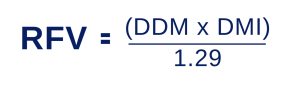
Where:
DDM (digestible dry matter) = 88.9 − (0.779 × ADF%)
DMI (dry matter intake as % body weight) = 120 ÷ NDF%
As NDF increases, the forage becomes bulkier, which may limit voluntary dry matter intake. As ADF increases, the digestibility of the forage decreases.
These two estimates are combined to produce the RFV score. The index uses full-bloom Lucerne as its reference point, with an RFV of approximately 100. Forage with a score above 100 is therefore ranked as having greater estimated intake and digestibility, and a score below 100 is regarded as having lower potential intake and digestibility than the reference forage.
What is Relative Forage Quality
Relative Forage Quality (RFQ) was developed to improve on some of the limitations of RFV.
While RFV is based solely on ADF and NDF values, the RFQ prediction utilises CP, ADF, NDF, fat, ash and NDF digestibility (NDFD48) in its calculation to produce a scored indicator of overall forage quality.
The inclusion of fibre digestibility within RFQ is particularly important. RFV assumes that forage with a particular ADF concentration will have a predictable level of digestibility, but this is not always the case in practice. RFQ accounts for further factors influencing potential intake and feeding value.
This is especially useful when comparing grasses and mixed forages. Grasses often contain more NDF than legumes, but their fibre may still be highly digestible. As a result, RFV may rank some grass feeds lower than their actual feeding value suggests. RFQ is generally better able to recognise these differences and provide a more representative comparison of forage quality.
Does the score mean the same thing for every feed?
RFV and RFQ are most useful when comparing feeds of a similar type.
For example, RFV can help compare one lucerne hay with another lucerne hay. However, directly comparing lucerne, cereal hay, tropical grass hay and silage using RFV alone can be misleading.
Plant species, maturity, growing conditions, leaf retention, weather damage and harvesting methods can all influence fibre concentration and digestibility.
RFV may undervalue a grass forage with highly digestible fibre. It may also overvalue a forage that has acceptable ADF and NDF results but is low in protein, affected by mould or unsuitable for the intended livestock class.
RFV and RFQ should not generally be used to compare feeds such as grain, concentrates or complete mixed rations. They have limitations when applied to feeds where starch availability contributes substantially to nutritional value.
What does a score tell you?
It is important to note that if the score is within 5 points of each other it should be regarded as essentially the same result, while more than 10 points difference is a meaningful difference when comparing forages based on RFV & RFQ.
A higher RFV or RFQ generally indicates that the forage has the potential for greater intake and digestibility. Though this does not automatically mean it is the best feed for every animal.
High-producing dairy cows, growing cattle or lactating ewes may benefit from highly digestible forage. Dry cows, horses, mature beef cattle or animals with lower nutritional requirements may need a different balance of energy, protein and fibre.
The most expensive or highest-scoring hay is not necessarily the most economical choice. The right feed is the one that suits the animal, the production target and the total ration.
Neither RFV or RFQ provides a complete assessment of feed quality. You should use these scores as the basis to dig a little deeper into the quality certificate; understanding that the protein, energy, sugar, mineral results must match production requirements.