Soil Nutrition Video Series with Neville Janke
Join us for our soil nutrition series with our Fertiliser Specialist & National Account Manager - Neville Janke.Below you'll find transcriptions of the above videos, if you'd like to review the information on soil nutrition.Hello, I'm Neville Janke and welcome to...
Feed testing: Calculating the benefits
Tanya Dobrijevic, Agriculture Victoria, 13/10/2023 Feed is more than just hay or grain, it is the energy and protein content that is most important. It is critical to purchase feed that is appropriate for your stock and meets their nutritional requirements. A simple...
Six Key Factors Influencing Today’s Hay Market
Our Director Tim Ford recently presented at the NSW DPI Dairy Breakfast. Tim's presentation provided valuable information on the current state of the Australian hay market, touching on various factors influencing it, and today we'd like to share those with you....
Parthenium Weed Alert
Parthenium is a noxious weed that can have negative impacts on humans, animals, and the environment alike. Feed Central is very conscious of the risk of Parthimium in hay in the affected Queensland Area, and makes all efforts to minimise risk. Parthenium weed is...
Why Does Hay Get Dusty And What Causes It?
Dusty hay can present challenges for both livestock and farmers. It affects palatability, and nutritional value, and can even pose health risks to animals. Today we will delve into the reasons why hay gets dusty, explore its causes, discuss the importance of...
What is Shedded Hay?
Here at Feed Central, we facilitate the sale and transport of hay from grower to consumer from farms across Australia. We deal with hay stored in a wide variety of ways, exposed to a range of conditions. Most buyers prefer shedded hay, as it maintains quality and...
Everything You Need To Know About Potassium and Horses
Potassium is a mineral that is found in many foods, and it is also necessary for horses. It plays a big role in balancing osmotic pressure, which is essential for cell function. It is also a key component of electrolyte balance, which helps regulate nerve and muscle...
How Potassium Affects Dairy Cattle
For lactating dairy cattle, potassium is an imperative nutrient that optimizes milk production. The Nutrient Requirements for Dairy Cattle from the National Research Council indicates that extreme potassium deficiency in lactating cows (defined as 0.06% to 0.15%...
The Visual Gauge And How It Works
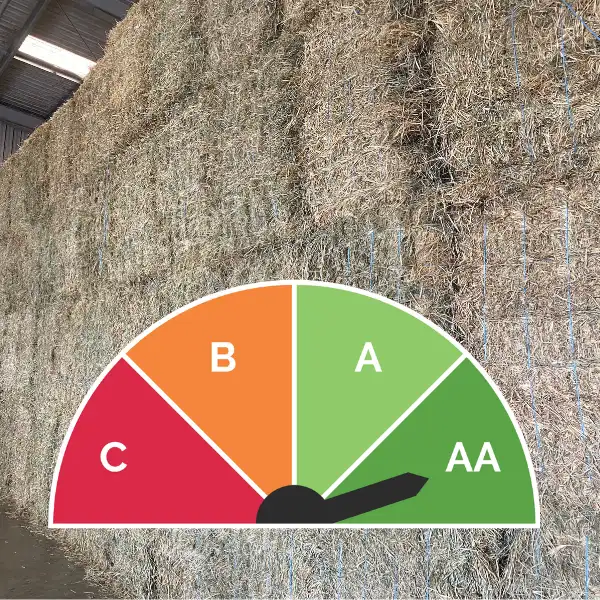
Why Is Visual Grade Important? Visual Grade has a very strong correlation to the attractiveness of the hay (for the livestock), that is livestock are much more likely to eat and be attracted to really nice-looking hay. In addition, there is a direct correlation...
Fire Ants & Hay – Here’s what you need to know
At Feed Central we understand the importance of NOT spreading fire ants when working with hay and other baled products. We also understand how important it is for each of us to play our own part. Fire ants are small, but they can have devastating consequences on the...
How To Tell The Quality Of Hay Visually
WHY IS VISUAL GRADE IMPORTANT? Visual Grade has a very strong correlation to the attractiveness of the hay (for the livestock), that is livestock are much more likely to eat and be attracted to really nice-looking hay. In addition, there is a direct correlation...
The Ultimate Guide – How To Stack Hay Bales
As your hay importation and exportation business grows, the amount of hay you’ll store on your farm or facility will as well. The time will inevitably come for you to stack hay bales to make more space. How do you do this? When stacking hay bales, ensure that each...
Hay Corers – What You Need To Know
What is the nutritional value of your hay bales? This isn’t something you can just guess by eyeballing it. Rather, farmers rely on a qualified system of measurement (feed test) after utilising a hay corer to take a good, representative sample. What is a hay corer? A...
Hay vs Silage – Pros & Cons
Many people ask us if hay is better than silage and vice versa. The answer will depend a lot of the end user and what type of cattle you are feeding. From Feed Central’s experience the key strengths and weaknesses of Hay and Silage production are summarised below: Is...
What Do Hay Buyers Really Want?
In summary, here’s what Feed Central Hay buyers want: Heavy, large, square bales (8x4x3) that maximise freight and handling efficiencies at every stage. High density (HD) balers that can deliver this size bale are now highly preferred. Feed with high Energy & good...
What Prevents Your Hay From Selling?
We talk to a lot of producers about what will help your product sell but this season we wanted to outline some notable issues that could affect the saleability of your Hay. Here they are: NOT KNOWING THE QUALITY OF YOUR HAY » Have you got your Hay Quality Assured...
How To Pick a Hay Contractor
Machinery manufacturers have put a lot of effort into producing a solid and heavy baler over recent years. So (as a generalization) a contractor with newer gear should be able to make heavier and better-shaped bales than a contractor with older gear. Here’s a few...
Total Fatty Acid Results, Why Are They Important?
WHAT ARE FATTY ACID RESULTS? Total Fatty Acids (TFA) give a more defined and accurate measurement of fat content in feed and indicate the energy content of a feed source. WHY ARE FATTY ACIDS IMPORTANT? Fatty acids (FA) play an important role in maintaining...
The Reality Of Selling Hay Off The Paddock
This season (21/22) we expect to see limited buyers purchasing Hay off the paddock. It’s important to remember that livestock eat 365 days of the year, not just when you are making Hay. You will need to consider these things when selling hay off the paddock. Unlike...