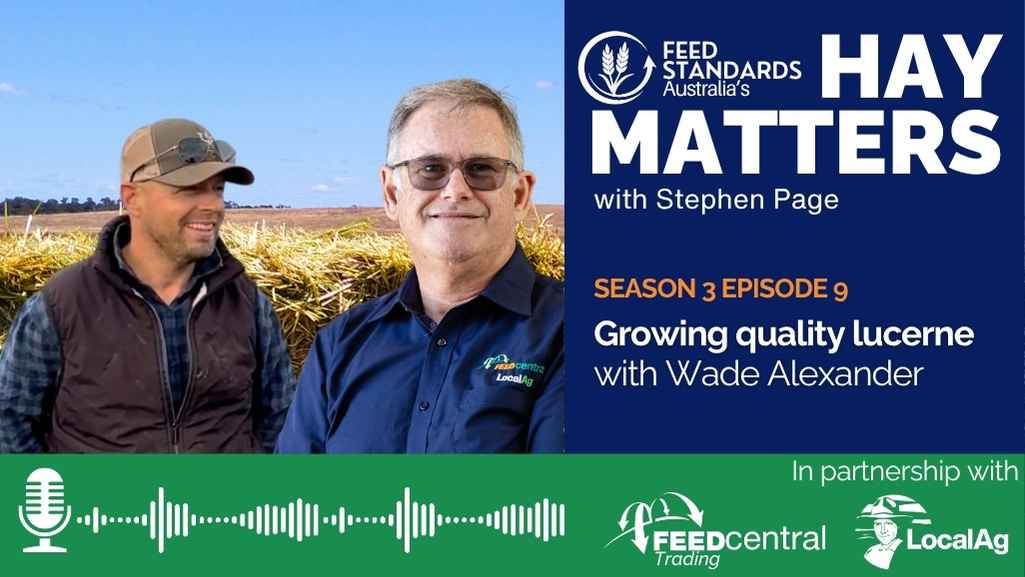
What goes into producing award-winning lucerne hay?
In this episode, Steve Page joins Wade Alexander on farm to explore the practical decisions behind his National Lucerne Feed Test Award win.
Walking through the paddocks, Wade shares his experiences with establishing and renewing lucerne stands, incorporating barley and oats, and adjusting his haymaking approach to the weather. Their conversation covers mower setup, drying strategies, beneficial insects and the balance between feed quality and yield.
They also discuss the pressures of rising input costs, investing in more efficient equipment and taking calculated risks to keep improving.
In this episode:
- Feed quality beyond protein: how energy and neutral detergent fibre (NDF) contribute to feed test award scoring.
- Lucerne establishment and renewal: Wade’s approach to planting, irrigation and preparing ground for a new stand.
- Companion cropping: incorporating cereals to help fill the early spring production gap.
- Beneficial insects: observations from the paddock and seasonal changes in pest management.
- Mowing and curing: machinery setup and adapting tedding and raking to wind, sunshine and rain.
- Business decisions: balancing costs, investment and the willingness to try something different.
Listen now for an honest paddock conversation about what works in Wade’s operation, what he’s learned and why adapting matters.
Hosted by Steve Page and presented by Feed Standards Australia, with partners LocalAg Marketplace and Feed Central Trading.
Read Transcript
Tim Ford 0:06
Hello, I’m Tim Ford. Welcome to Hay Matters, brought to you by Feed Standards Australia with our partners Local Ag Marketplace and Feed Central Trading. Each episode, we share practical information, industry insights, and real experiences from across Australia’s hay and fodder industry. Now let’s get into today’s episode with our podcast host and grower services manager, Steve Page.
Steve 0:35
Welcome back to Hay Matters and the Think Standards Australia podcast. It’s Steve Page here. On today’s episode, I’m speaking with Wade Alexander and his award-winning Lucerne, and how he approaches growing and making quality hay. You’ll hear that we’re out on the farm from the conversation, so there’s plenty of birdsong and the sounds in the paddock in the background. Enjoy this conversation with Wade. Good morning, Wade. Back again. Good to see you again, and congratulations, the National Feed Test Award winner for the Lucerne. Well done again.
Wade Alexander 1:10
Thanks
Steve 1:12
So, what can you put that award down to this year? What was that line of Lucerne? Can you remember much about it, and why it did so well?
Wade Alexander 1:21
I remember it was a challenging year making hay, and I’m not sure what it was. Might have been the fog or the conditions to to make something that looked visually appealing. It was difficult. As for the the feed test, I think it was just it was a new lucerne, new stand loose and freshly planted. It was would have been second, third cuts. Yeah, and yeah, would have been at just an optimum time of the year, and just get lucky Steve.
Steve 1:54
Lucky again. You have a lot of luck, mate, because I’m here on a fairly regular basis.
Wade Alexander 1:58
Yeah, but I use it all up on a lucerne stand and not a lotto ticket.
Steve 2:03
Yeah, no, well done, congratulations. You, if I remember right, the feed test side of things was quite tight.
Wade Alexander 2:11
It was in point four, wasn’t it? Like on their protein. Yeah. Compared to the other fellas at down south. Yeah. The NDF might have been better, I think.
Steve 2:20
Yeah, so it is up here. It with the and I’d have to check, with the actual feed test side of things. It’s not only protein; it’s energy and it’s NDF, and so it’s a combination of those. So you can have identical, and sometimes we do identical actual energy or identical protein, so that is actually calculated all between the three, and they’re weighted. So you’ll have a different scoring on your cereal hay to what your lucerne or your vetch is in in the actual feed test results. Yeah. So it’s weighted differently in there because we look more for protein in lucerne and vetch, where we don’t look for protein in the cereals. So the cereal is more energy. Yeah. So and that’s the way the market wants it. So yeah. So you might see that someone’s got you know within 0.4 of your protein or whatever. That’s part of it. Yeah. So you could have two identical results from the protein, but you win it because of the energy, or you win it because of the NDF. Yeah. So NDF is extremely important.
Wade Alexander 3:27
Yeah. Generally, it’s I found like just talking in there. It’s the NDF in this area that seems to get it over the line every time.
Steve 3:32
Yeah. Yeah.
Wade Alexander 3:34
Everything gets planted May.
Steve 3:36
Yeah.
Speaker 1 3:37
And you get like mid May, and then you get your showers in June, which help. We always seem to get the June showers, I call them, which help establish your lucerne. And like I don’t bury the lucerne seed; I just put it on top. And I plant in rows, which is hard to tell, but I do plant in rows, five five-inch spacings.
Steve 3:59
Yep, what sort of planting rate?
Wade Alexander 4:02
25 kilos of hectare, and you just keep it wet. And those June showers are good because it gets to a point where, to a height where you don’t really want to damage it with irrigation. It’s all right with a pivot or a lateral, but when you’re when I planned this, it was with hard hoses, watering it up with hard hose like a gun. So it can be quite damaging.
Steve 4:22
Yep. And yeah, I think we’ve spoken before. You get about four years before you four to five years, or three years. Yeah. Yep. And then bring it back out.
Wade Alexander 4:33
I aggressively cultivate. There’s ripping and there’s square ploughing. There’s turning this all upside down and roundabout, and really, really give it a hard time. And I do it in a normally in a three-month window, and then replant into the same ground again. And I mean, a lot of people recommend putting in cover crops and a different crop and. And yeah, I’d like to, but the demand-I haven’t got much country, so the demand for the lucerne sort of has kept me planting back-to-back.
Steve 5:11
But you were talking there before about that you plant a cereal into it, like a barley into a stand, and then yeah, and then let the lucerne come up through it, and you’re talking about actually being with that barley, you’re planting and being able to get two cuts off that barley with the lucerne in it.
Wade Alexander 5:28
Yes, yes. So I found just by drilling and just by disturbing the ground after a year or two of mowing, raking, baling every four weeks does the ground a load of good. Like the lucerne really responds after that bit of a tickle. I’m not sure what it’s doing. Whether it’s releasing something out of the ground. And I also, when I do drill, I also just put a bag of lucerne seed in the barley mix as well.
Steve 6:00
Well…
Wade Alexander 6:00
just if there are any bare patches, it just helps cover that.
Steve 6:03
Yep.
Wade Alexander 6:04
Yeah. So that’s probably one of the reasons. Another thing is to fill that void in that early spring, putting the barley in. The first the first cut is generally an all barley cut. The second cut is a half half.
Steve 6:20
Yep.
Wade Alexander 6:21
Half loosen, half barley. We may, after the first cut, we may just give it a top dress urea, 120 kilos a hectare, and then water it back up.
Steve 6:32
Yep.
Wade Alexander 6:32
The lucerne’s not that affected by it. The barley does thrive on whatever the lucerne’s put there to start with.
Steve 6:39
Yep.
Wade Alexander 6:40
So generally, it’s just a bit of a general fertisiser normally.
Steve 6:44
That companion cropping, it’s amazing what sort of yields you can get off that. And so if that with that barley/lucerne what first cuts are you’re doing, when are you cutting that?
Wade Alexander 6:56
Well, starting now, yeah, end of August, September. We’re just waiting for a window. We’ve been waiting for a window with a bit of heat and a bit of wind, which we may have it these coming days. So, we’ll still need two weeks to dry it, minimum. So, and then yeah, the second one sort of late October, November. Yep, and generally it’s a little bit more lucerne because it’s starting to grow a bit quicker as days warm up and the daylight hours come longer.
Steve 7:26
So that first cut, you’re cutting that quite early. It’s only just starting to flower, and it’s out of out of the boot stage.
Wade Alexander 7:34
no, it’s not out of the boot at all.
Steve 7:38
Not out of the boot.
Wade Alexander 7:39
No and you get a look at that, and no, it’s just leaf.
Steve 7:43
Yep, yep. And you’re getting it dry, or the heads aren’t even formed.
Wade Alexander 7:47
The heads aren’t formed I don’t think so. Well, I haven’t looked recently, but I, yeah, it’s it makes a nice soft small square bale hay, and that’s what that’ll go into small squares.
Steve 7:59
Yes,
Wade Alexander 7:59
my stuff will obviously go into big squares,
Steve 8:02
yeah.
Wade Alexander 8:02
But it’s more oats,
Steve 8:04
yeah.
Wade Alexander 8:05
But yeah, no, it. I prefer to. I’ve got still barley hay over there that was cut prior to fflower.
Steve 8:12
Yeah.
Wade Alexander 8:17
I hear different reports like when you got an oats crop or a barley crop that’s flowered and it’s you know chest height. You get the bulk, that’s good, but I don’t know whether the quality’s there in the feed. Unless you’re chopping it. I just see cattle will hang off a bale that’s very leafy, intensely leafy, and young. Andwe stop watering too, so we let that crop struggle a bit in that leaf point.
Steve 8:51
Locks in those nutrients, that’s right.
Wade Alexander 8:55
Yeah, and and yes, it it struggled, but it hasn’t thrown up any flower. It as a bit of a you know get me out of here sort of thing, but it’s maybe because it’s been looked after to that point where it’s sort of it’s grown to here.
Steve 9:11
Yeah
Wade Alexander 9:11
And then it’s just gone, you know. ‘Oh, what are we doing now’? And then I’ve just shut the water off, and I want the ground pretty dry to get the get the hay off, so I don’t know. Look, it works for me.
Steve 9:26
Here we are walking across to the next stand in the next paddock with Wade, and he’s pointing out the beneficial insects that he has within his paddock and his production of hay.
Wade Alexander 9:38
See this little fella here? Yep, ladybug.
Steve 9:42
so that’s beneficial.
Wade Alexander 9:44
That’s a beneficial.
Steve 9:46
Yep, yeah, love a ladybug.
Wade Alexander 9:48
Yeah, so he’s sitting on top of that leaf because there’s obviously an egg or something from an aphid or a moth
Steve 9:55
okay,
Wade Alexander 9:56
or a flea.
Steve 9:57
So is that a little flea?
Wade Alexander 9:58
That’ll be an egg of something. Yeah, that he’s chasing.
Steve 10:01
Right.
Wade Alexander 10:02
Yeah, that’ll be like a sucker.
Steve 10:04
So is that what’s causing those spots on the leaf?
Wade Alexander 10:09
Yeah, I’d say so. Because I’m going to mow it shortly. It’d be probably more than three weeks since I put a pesticide on it.
Steve 10:17
Yep.
Wade Alexander 10:17
And it was a a systemic pesticide anyway. So, but yeah, they’ll be just sort of cleaning up, and then when it’s cooler, you don’t see a lot of beneficiaries. Yes, I mean when we breed beneficiaries in town, it’s got to be in a climate that’s you know 25 (degrees) and 60% humidity, and so when it starts warming up in the spring, throughout the spring summer, you’ll start seeing a lot more of them.
Steve 10:40
Yep.
Wade Alexander 10:40
And then when it gets into the early year, so like your February/March, they we tend to spray a lot more because the humidity knocks their production around.
Steve 10:56
Right.
Wade Alexander 10:56
So beneficiaries are good, but they like it. They’re a Goldilocks approach to life.
Steve 11:01
Yep.
Wade Alexander 11:01
Whereas your pests love humidity. So, in there we breed pests in humidity.
Steve 11:09
Right.
Wade Alexander 11:10
And warmer conditions, and yet for the beneficiaries they like it cooler and less humid.
Steve 11:15
So while you’re breeding the pests,
Wade Alexander 11:17
You’ve got to feed the beneficiaries.
Steve 11:19
Okay
Wade Alexander 11:21
So you got to have one to feed the other.
Steve 11:23
So do you look at how many beneficiaries you’ve got in that? Do you actually monitor how many beneficiaries you got in a square metre, or not really?
Wade Alexander 11:31
No. And because it’s very seasonal and weather dependent, and also I mean, around October, November, December. Your mower deck is full of beneficiaries after you finish mowing. And we do spray less. You just know it when you with your use of chemical and so forth, and the nature of the paddock too. Like I mean, yes, the crop’s got some. I mean, it’s been sitting here a while. That’s why it’s sort of got some damage in it. And you’ll see damage in the leaves. You’ll see markings. None of it’s this real rich green like that. The new green, but there’s a beneficiary sitting there.
Steve 12:14
Yep.
Wade Alexander 12:16
But in the months where you’re cutting it every three four weeks. There’s a lot more fresh growth there, and it’s a lot easier to control.
Steve 12:24
Yep.
Wade Alexander 12:29
I tilt the mower right back on the heel of the cutting deck, and I lift the front edge up, and it just stops dragging anything. So you’re going to get clods. You’re going to get old root stock. You’re going to get the odd bit of debris in the paddock, and it just sort of allows the mower to just sort of skip over it. So, the next cut, yeah, you just sort of get shorter and shorter as your paddock gets rolled in with just the traffic. You get less debris on top. You get less drag because now you’ve got the odd clod that will, if you do have the the tail of your cut deck facing into the crop, and drag in first, you will drag clods of mud under the cutting deck, and you’ll get this build-up of mud, and then slowly your cutting deck gets lifted, and then it starts pushing the crop over, and you’ll see these lines down the paddock and it just looks messy, and that’s generally because of the build-up under your cutting deck. But keeping clear, lets you float over any rubbish. And as you can see that I’ve made here, it’s a clean cut. There’s nothing dragged, and also just by leaving that bit of loosened stalk behind, it helps keep the crop off the ground in the initial drying period.
Steve 13:55
So what what Samoa conditioner you’ve got?
Wade Alexander 13:58
Just a John Deere Mo-Co. Yep. Rubber rollers. I’ve thought about going steel. I don’t know why I haven’t gone steel. I think maybe this last mower I bought there was a special deal because no one wanted it because it had a rubber roller. So, I just bought it because it was cheaper. If steel becomes available, I’d probably go steel and be happy with steel.
Steve 14:23
So what? What are you hoping? What benefits are you hoping to get out if you change to steel?
Wade Alexander 14:28
Probably less wear on the on the roller itself.
Steve 14:31
Yep.
Wade Alexander 14:32
Because after three years, there’s a lot of wear in it, and I don’t think I get the crimping. And yeah, you either replace it. In my case, I just I trade the mower. Yep.
Steve 14:43
So how long? How old this one now?
Wade Alexander 14:46
Be two years, I think.
Steve 14:50
Yep. And so this was only cut when?
Wade Alexander 14:53
Yesterday. Last night.
Steve 14:56
ok last night.
Steve 14:57
So what’s the programme for this now?
Wade Alexander 14:59
I’ll just let this sit for a while, just to dry out anything in between the windrow, and then I’ll probably just-it’s not a very thick cut, so I don’t know whether I’ll ted it. I’ll just probably break singles. I’ll just put the wet stuff on the dry ground. So, the top to dry, and then I’ll leave that for a few days to dry out where that was. Yes. And then I’ll probably just put it back again. If there’s forecast wind, I’ll leave it in a wind row. If it looks like it’s the wind’s going to drop off and we’re going to get a bit of sunshine, I’ll ted it out.
Steve 15:31
Yeah.
Wade Alexander 15:31
And let the sun do the work, not the wind.
Steve 15:34
And how long would you have it tedded out for? Four days, five days.
Wade Alexander 15:39
It’ll just be a a look see what happens with yeah look see every day and and feel it
Steve 15:45
yeah and there is a potential that they’re talking about it I don’t know whether it’s going to be up this far but of rain coming in the next few days.
Wade Alexander 15:53
For a couple of days now we’ve got a mm which would be just this coast of stuff which would be the odd shower of a mm, we’re not going to get it.
Steve 16:03
Yep. If you did it, what would that change? What would? How would you change the management? Don’t touch it.
Wade Alexander 16:10
Don’t touch it. People make the mistake of getting hay wet and then and getting in there thinking they’ve got to dry it. Don’t touch it. The moment you start touching it, the moment it’s almost like you’re think of putting liquid into a cake mix, and you’re stirring that liquid in, and I mean once you get that liquid in this that moisture in the in the windrow- the moment you start raking it you’re just stirring that liquid in, it’s harder to get out then.
Steve 16:40
Yeah,
Wade Alexander 16:41
let the environment do the work for you. You know, let the thermal activity that heat creates get the moisture out for you. I mean, we look here at windrows, and as soon as you get thermal activity in your windrow, you get hay windrows disturbed. Your hay’s dry.
Speaker 2 17:00
Yeah,
Wade Alexander 17:00
It’s got the moisture out.
Steve 17:03
Here we are walking across to a paddock of oats and barley with a lucerne through it, in the next stand that Wade’s going to be discussing with us.
Wade Alexander 17:13
But as you can see, some of it, yeah, that’s a bit unfortunate, but timing. It is a bit said. What I like is the oats. That’s that’s the oats in Lucerne. There you can see the difference with the barley. Yes. How it’s already shot. Yet the oats hasn’t. Probably a little bit.
Steve 17:37
Yeah. See. So that’s the actual head in the boot stage. Yeah. And that is extremely hard to normally get dry, because it’s so fibrous in there and so thick. Really, I have seen people do it, so they cut it with a mower conditioner, and they come back in soon after, within a few days, and hit it with a super conditioner.
Wade Alexander 18:02
Oh yeah,
Steve 18:03
And then bale it. But with your lucerne in that, I think it would actually then really shatter your lucerne.
Wade Alexander 18:09
I tedder it.
Steve 18:11
Yeah, tedder it out. Okay.
Wade Alexander 18:14
Yeah
Steve 18:15
Gee, that’s going to take a lot to do.
Wade Alexander 18:17
It does. Like I said, I’ve got to inoculate it.
Steve 18:20
Yes. Oh, yes.
Wade Alexander 18:21
Not 100% No. Next one is though.
Steve 18:24
I love inoculant on lucerne, and on vetch. I think really anyone doing lucerne or vetch should be using some sort of inoculant. It helps really make the quality of it better. Yeah. The inoculant will really only help you by a couple percent of moisture. So you don’t want to be pushing the inoculant too hard.
Wade Alexander 18:49
As I said, it does take time to get it, and that’s why I sort of I have not watered it, but trying to dry down a bit. Yes.
Steve 19:01
Yep.
Wade Alexander 19:02
But then it does this sort of thing, which shoots a bit of the head out.
Steve 19:15
That’s going to be a lot easier to dry down than that other one we just looked at because you’ve got all that fibrous material out,
Wade Alexander 19:22
yeah.
Steve 19:24
So I would sort of be looking at sort of getting that dry, getting that out before you cut it. But if you’ve been getting away with it, so when you ted it how quickly after you’ve cut it?
Wade Alexander 19:47
Have to be three days.
Steve 19:49
Yep, and then tedder it again. What about a week after that?
Wade Alexander 19:53
Another three days.
Steve 19:57
Another three days. Yep, and then raked it into singles.
Wade Alexander 20:01
Singles, and then just rake it single again. Right, and then the four and the one.
Steve 20:06
Right. Okay. So you you’re hitting it a bit, yeah. Yep. And that’s possibly why there’s not a lot of lucerne in it.
Wade Alexander 20:14
I like to say is lucerne gets lost in it. Yep. Although this would have been probably a majority barley. Yep. Because this is planted with a new stand of lucerne. Right. So the lucerne would have been quite young underneath it.
Steve 20:26
Yep. Do you know what it roughly yielded?
Wade Alexander 20:31
I’d be lying if I told you something. Yeah. it was a lot.
Steve 20:41
So, this is your first cut, and then you got another cut off after that.
Wade Alexander 20:47
yeah. I mean, because the lucerne being young it came through.
Steve 20:50
What variety lucerne have you got?
Wade Alexander 20:54
It would have been 63, old 63, or I’ve changed it now. Jen Ag,
Steve 21:02
Jen Ag. Yep.
Wade Alexander 21:06
Used to be….
Steve 21:07
beautiful, soft.
Wade Alexander 21:10
But yeah, when Kimberley came, it was would have been probably in here four months maybe.
Steve 21:17
Yep.
Wade Alexander 21:18
And yeah, it was quite green. You asked her about it
Steve 21:20
Yeah
Wade Alexander 21:20
Because she couldn’t believe it
Steve 21:23
Yeah,
Wade Alexander 21:23
She’s like, “Why don’t you send a little test”?
Steve 21:29
Here we are talking about the bigger picture of farming at the moment with Wade and the challenges ahead.
Wade Alexander 21:38
The inputs, you know. There isn’t a margin there from your input to your output to be able to have a mistake.
Steve 21:50
Yeah,
Wade Alexander 21:52
It does make you better at what you do. But you’re not taking risks, you know, or not huge risks.
Steve 22:05
Yeah, not taking the big risks. You need to take, as I say, you need to take those little risks to keep moving forward, because you only learn by mistakes. So you make a mistake that you can sort of still get your costs out of, yeah, recover your costs, but you’ve learnt from that to then try something or move forward with something else the next year. Calculated risk.
Wade Alexander 22:26
Yeah, and with no, you know, someone like myself, no farming background….
Steve 22:34
You have now. How many years he’d been doing it?
Wade Alexander 22:38
I mean, yeah, like it’s just grandfather didn’t own the farm, and he’s going to own the farm, and you don’t have that generational knowledge passed on.
Steve 22:49
Yep,
Wade Alexander 22:49
And maybe that could be an advantage because I’m willing to try different stuff.
Steve 22:53
right. Yes. Yep. You know,
Wade Alexander 22:54
Maybe I look at things in a different light.
Steve 22:56
Yes, and that’s what you see. You see different farmers move from one location or one area of well the world or Australia into another region, and they will be doing something totally different than those that have been there for three, four generations in that region. Yeah, and you’re doing something different than what the locals do. They look at you and give you a hard time, but then you know, then what you’ve done works, and they’ll move along with you. And that that’s good to do. You try different things in different regions. I see that quite a bit with driving around and looking at what someone does in one area and then talking about it in another area. You get that information passed on, and people may think it’s a bit crazy to begin with, but maybe it works.
Speaker 3 23:41
Yeah,
Steve 23:42
And maybe it doesn’t.
Wade Alexander 23:43
I mean, it’s interesting. You probably noticed too down south, a lot of farming practices have been slowly changing. You know, from just a talk on the computer the other day. You know, from wheel rakes to rotary rakes to basket rakes and that sort of thing. I guess there’s advantages in trying different stuff if you’ve got the financial capacity to be able to.
Steve 24:08
M
Wade Alexander 24:10
It’s also helpful, but if you’ve still got you know the farming practices of many years ago, well, I don’t know whether the seasons are the same as many years ago either.
Steve 24:20
Well, and we’ve got different things happening, as you say. Like you’ve moved from you know that irrigator you had there.
Steve 24:30
To to your lateral-move, and look at the changes that’s made for your operation. So you’re more efficient.
Wade Alexander 24:36
Well, you had to. Yeah. And that’s. I mean, we’re being forced to. It wasn’t by choice. We’re being forced to.
Steve 24:42
Yeah, yeah. So it’s made you are more water efficient.
Wade Alexander 24:44
I don’t know. It’s brought us in the debt too.
Steve 24:49
It’s more water efficient, more time management.
Wade Alexander 24:51
Yeah,
Steve 24:52
Better time management. So yes, allowing you to do different things.
Wade Alexander 24:57
In in the long run there’ll be return. I mean, it’s a bit hard to stomach it at the start because you think, oh, you know, we’re making the right decision here. Your heart’s got to be in it to keep going.
Steve 25:12
You’ve got to look at the long term. Thanks again to Wade for talking to us and having us around the farm and sharing some of the thinking and experiences behind his award-winning Lucent. And thanks again for listening to Hey Matters.
Tim Ford 25:34
Tim Ford here again, and thanks to Steve for another great podcast. Don’t forget to follow or subscribe in your favourite podcast app, leave us a rating and review, and share this podcast with a friend. This podcast is hosted by Steve Page, presented by Feed Standards Australia, and sponsored by Local Aid Marketplace and Feed Central Trading. The producers are Cara Stewart and Denise Ellis. The audio editor is Ellen Rolls Keane, and the music is by Piano Yu.